
Summarise With AI



The Kerala Engineering Architecture Medical Entrance Examination (KEAM) is one of the most important state-level entrance tests for engineering aspirants seeking admission to top colleges in Kerala. Candidates who appeared on 20 April 2026 can now check the complete KEAM Paper Analysis 2026, including subject-wise difficulty level, students’ reactions, expected marks, rank trends, and safe score estimates.
This detailed KEAM 2026 exam analysis is based on student feedback, memory-based questions, and expert review. Students can also compare today’s exam with previous shifts to understand trends in the KEAM question paper pattern.
CollegeDost brings you the detailed analysis along with the students’ reactions and important topics that have been asked. Students can get all the KEAM Paper Analysis 2026 for all the days on the CollegeDost platform, along with the answer keys and memory-based questions for them to analyse and prepare for the upcoming exams.
You can check all the KEAM Paper Analysis of the previous shifts here:
- KEAM Paper Analysis April 17 2026
- KEAM Paper Analysis April 18 2026
- KEAM Paper Analysis April 19 2026
How Good is Your KEAM Score? Check Your Rank Here! Turn your expected marks into rank possibilities.

KEAM Paper Analysis 2026 Highlights
Here is a quick overview of the KEAM 2026 exam held on 20th April. The table below summarises the key details of the paper for candidates’ reference.
| Particulars | Details |
| Exam Name | Kerala Engineering Architecture Medical Entrance Examination |
| Conducting Body | CEE Kerala |
| Exam Shift Date | 20th April 2026 |
| Exam Time | 2 PM to 5 PM |
| Mode of Exam | Computer-Based Test |
| Medium of Language | English |
| Subjects | Physics, Chemistry, Mathematics |
| Duration | 3 hours (180 mins) |
| Total no. of questions per paper | 150 |
| Total marks per paper | 600 |
| Marking Scheme | +4 for correct –1 for incorrect |
| Questions Per Subjects (Engineering) | Mathematics: 75 Physics: 45 Chemistry: 30 |
| Official Website | CEE Kerala |
KEAM 2026 Paper Analysis: Subject-wise Analysis
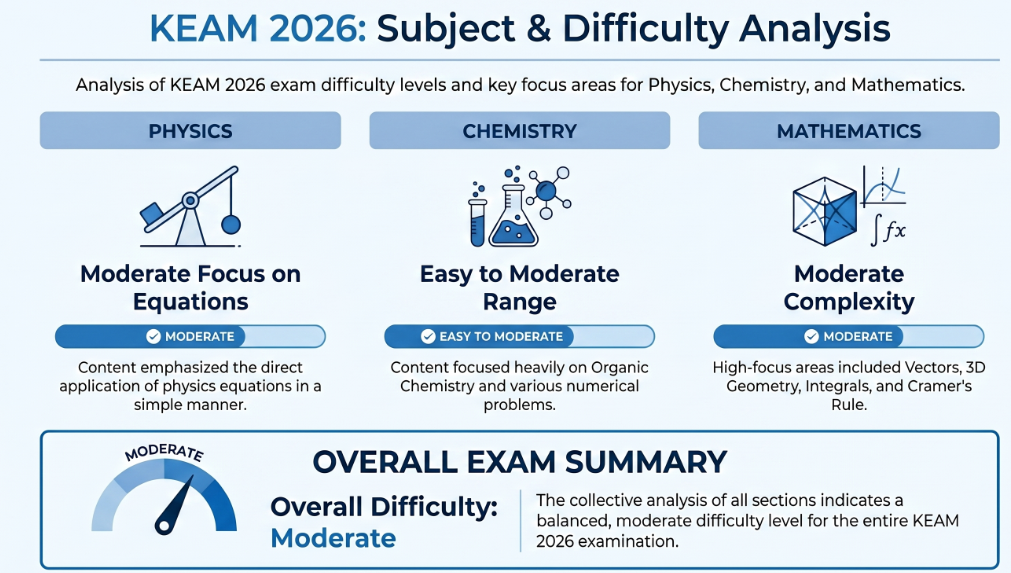
The KEAM 2026 difficulty level was reported as Moderate overall. Mathematics was the toughest section, while Chemistry was the easiest.
| Subject | Difficulty Level | Topics Asked |
| Physics | Moderate | The section was relatively simple and focused on the direct application of equations |
| Chemistry | Easy to Moderate | Organic Chemistry, Numerical problems |
| Mathematics | Moderate | Vectors and 3D Geometry, Integrals, Cramer’s Rule |
| Overall Difficulty | Moderate | |
Memory-Based Chemistry Question For KEAM 2026
According to students who appeared for the exam, the paper followed the expected KEAM exam pattern. Most students found the paper manageable with enough time if planned properly.
Q1. Which among the following is most basic in an aqueous medium?
i) Benzenamine
ii) N-ethylethanamine
iii) N, N-diethylethanamine
iv) Methylamine
Answer: ii) N-ethylethanamine
Q2. Arrange the isoelectronic species in increasing order of ionic radius:
Al3+, Na+,F-,O2-
i) Al3+ < Na+ <F- < 02-
ii) O2- <F- < Na+ < Al3+
iii) Na+ <F- < A13+ < O2-
iv) F -< Na+<02 -< A13+
Answer: i) Al³⁺ < Na⁺ < F⁻ < O²⁻
What are the Students’ Reactions of KEAM 2026 20th April Exam?
According to the students who appeared for the KEAM 2026 20th April exam, the paper had a moderate difficulty level. Chemistry was seen as the easiest section, Physics was simple and scoring, while Mathematics turned out to be the most challenging part of the exam. Here is the subject-wise reaction shared by students.
Chemistry
According to students, Chemistry was the easiest subject in the exam. Most questions were direct and based on the NCERT syllabus. Many students noticed numerical questions along with Organic Chemistry topics. Due to its easy level, several students chose to attempt Chemistry first.
Physics
Students found Physics simple and manageable. Many said it was easier than the mock tests they had practised earlier. Questions were mostly formula-based with direct application, and there were no assertion-reasoning type questions. Some students completed this section quickly, while a few found one or two questions slightly lengthy.
Mathematics
According to students, Mathematics was the toughest section of the paper. Many candidates said they could not attempt several questions easily and had to depend on their Class 11 and 12 concepts. Topics like Integration were considered lengthy and difficult, while some direct questions came from Vector 3D and Cramer’s Rule.
KEAM 2026 Answer Key and Response Sheet
The KEAM 2026 Answer Key and Response Sheet are expected to be released by the Commissioner for Entrance Examinations (CEE), Kerala, shortly after the completion of the exam. The provisional answer key will help candidates compare their responses and estimate their probable scores before the official results are announced.
Along with the answer key, the response sheet will allow students to review the answers marked during the examination. If any discrepancies are found, candidates will also get an opportunity to raise objections within the given deadline. Checking the KEAM 2026 answer key is an important step for students to understand their performance and prepare for the next stages of admission.
Check the KEAM Answer Key 2026
Important Topics Asked in KEAM Exam Question Paper
After going through the KEAM Paper Analysis 2026, understanding topic trends helps students prepare with the KEAM previous year question paper.
| Subjects | Important Topics |
| Mathematics | Vector 3D, Integrals / Integration, Cramer’s Rule. |
| Chemistry | Organic Chemistry, Numerical problems, Direct NCERT-based questions. |
| Physics | Direct application of equations, slightly lengthy questions requiring two or three equations, and no assertion-reasoning type questions. |
KEAM Exam Pattern 2026
The KEAM exam pattern plays a key role in how candidates plan their time and preparation strategy. Knowing the number of questions, the marks distribution, and the subject weightage helps students approach the KEAM exam model question paper more effectively.
| Subjects | No. of Questions | Marks Per Question | Total Marks | Weightage (%) |
| Mathematics | 75 | 4 | 300 | 50% |
| Physics | 45 | 4 | 180 | 30% |
| Chemistry | 30 | 4 | 120 | 20% |
| Total | 150 | — | 600 | 100% |
Expected KEAM 2026 Marks v/s Ranks
The table below gives a rough estimate to help students understand the safe score for KEAM 2026 and where they may stand in the KEAM rank analysis. These figures are based on past trends, including KEAM 2025 cut-offs, and are indicative in nature.
| KEAM Score (Boards + KEAM exam) after standardisation | KEAM 2026 Ranks expected |
| 550+ | 1 to 5000 |
| 450+ | 5001 to 20000 |
| 350+ | 20001 to 50000 |
| 250 and below | 50000+ |
Safe Score for KEAM 2026
Students often ask what a safe score is for KEAM 2026. Based on previous trends:
- 550+ = Excellent score for top government colleges
- 470+ = Good score for reputed colleges
- 400+ = Competitive for many private colleges
- 350+ = Moderate admission chances
KEAM Cutoff 2026 (Expected)
Candidates aiming for admission to top engineering institutes in Kerala often look at previous closing ranks to understand their chances. The KEAM Paper Analysis expected cut off for government colleges provides an estimated idea of rank requirements for popular branches such as Computer Science Engineering.
These projected cut-offs are based on past admission trends, seat demand, and KEAM 2025 cut-offs, helping students plan their college preferences more effectively during counselling.
| Course | College | General |
| Computer Science Engineering (CSE) | College of Engineering, Thiruvananthapuram (CET) | ≤ 300 |
| Government Engineering College, Thrissur | ≤ 550 | |
| Govt. Model Engineering College, Kochi (MEC) | ≤ 1,000 | |
| TKM College of Engineering, Kollam | ≤ 1,100 | |
| Electronics & Communication Engineering (ECE) | CET, Thiruvananthapuram | ≤ 800 |
| GEC Thrissur | ≤ 1,200 | |
| TKM College of Engineering | ≤ 2,000 | |
| MEC, Kochi | ≤ 1,500 | |
| Electrical & Electronics Engineering (EEE) | CET, Thiruvananthapuram | ≤ 1,800 |
| GEC Thrissur | ≤ 2,500 | |
| TKM College of Engineering | ≤ 3,200 |
List of Colleges Accepting KEAM Scores
Several reputed engineering institutes in Kerala accept KEAM scores for admission to undergraduate engineering programmes. Through the counselling process conducted after the KEAM entrance exam, candidates can secure seats in top government, aided, and private colleges based on their rank, category, and seat availability. Knowing the major colleges accepting KEAM scores helps students make informed choices during option entry and admission planning.
- College of Engineering Trivandrum (CET)
- TKM College of Engineering, Kollam
- Cochin University of Science and Technology (CUSAT), School of Engineering
- Government Engineering College, Thrissur (GEC Thrissur)
- Model Engineering College, Thrikkakara
- Government Engineering College, Barton Hill
- College of Engineering, Chengannur
- Rajagiri School of Engineering & Technology, Kochi
- Mar Athanasius College of Engineering, Kothamangalam
- College of Engineering & Management, Punnapra
Is 470 a good score in KEAM?
A score of 470 in KEAM is generally regarded as a good and above-average score for engineering aspirants. This score can often place candidates within an estimated rank range of 5,000 to 10,000, creating opportunities for admission to reputed private engineering colleges and, in some cases, selected government colleges in Kerala, depending on the branch and category.
- Expected Rank Range: Candidates scoring 470 may secure a rank between 5,000 and 10,000.
- Admission Chances: This score offers strong possibilities for entry into leading private engineering institutes, along with chances in mid-level government colleges based on seat availability.
- Score Comparison: While scores above 550 are usually considered very competitive, 450+ is commonly seen as a solid benchmark for a good performance.
- Important Note: KEAM final rank is prepared using a 50:50 weightage of entrance exam marks and Class 12 board marks, so board performance also plays a major role.
Students can explore the CollegeDost KEAM College Predictor or use the KEAM 2026 Rank Predictor to check potential colleges and rank outcomes.
How To Prepare For Upcoming KEAM Exams?
Preparing for the upcoming KEAM entrance exam requires a smart strategy, regular practice, and strong conceptual clarity in Physics, Chemistry, and Mathematics. Candidates should focus on understanding the latest KEAM exam pattern, solving the KEAM previous year question paper, and practising mock tests to improve speed and accuracy. Consistent revision, time management, and topic-wise preparation can significantly boost confidence and help students achieve a high score in the exam.
- Practice with KEAM maths question paper regularly
- Solve KEAM previous year question paper
- Focus on NCERT Chemistry
- Revise formulas for Physics daily
- Improve speed for Mathematics
- Attempt CollegeDost KEAM mock tests with a timer
- Check the KEAM Paper Analysis 2026 and know the difficulty of each subject.
KEAM 2026 Exam Day Guidelines
Candidates appearing for the KEAM 2026 exam should carefully follow all exam day instructions to ensure a smooth and hassle-free experience. Reaching the centre on time, carrying the required documents, and following the rules set by the authorities are essential. Adhering to these KEAM 2026 Exam Day Guidelines will help students avoid last-minute issues and focus confidently on their examination.
| Guidelines | Details |
| Reporting Time | Reach the exam centre well before the reporting time mentioned on the admit card. |
| Admit Card | Carry a printed copy of the KEAM 2026 admit card to the exam centre. |
| Valid ID Proof | Bring a valid photo ID for verification purposes. |
| Dress Code | Wear simple and comfortable clothing, avoiding restricted items if specified. |
| Allowed Items | Carry only permitted items such as pens, a transparent water bottle, and required documents. |
| Prohibited Items | Do not carry mobile phones, smart watches, calculators, notes, or electronic gadgets. |
| Exam Hall Entry | Follow frisking and security checks before entering the hall. |
| Seat Allotment | Sit only on the seat assigned by the invigilator. |
| During Exam | Read instructions carefully and manage time wisely while attempting questions. |
| Discipline | Maintain silence and follow the invigilator’s instructions throughout the exam. |
Conclusion
The KEAM Paper Analysis 2026 April 20 shows that the exam was moderate overall, with Chemistry being the easiest and Mathematics the most challenging. Students who managed time well and avoided negative marking are expected to score strongly. Candidates should now wait for the answer key and use score estimates for better KEAM result analysis and admission planning.
Frequently Asked Questions
1. How is the KEAM Rank Calculated?
Final KEAM Rank = 50% (KEAM Score) + 50% (Standardised Class 12 PCM Marks)
2. What were the common strategies students used for subject order and time management in KEAM 2026?
For time management, many used fixed time slots for each section, solved easier subjects quickly to save extra time, and skipped doubtful questions to avoid negative marking.