
Summarise With AI



The Kerala Engineering Architecture Medical Entrance Examination (KEAM) is one of the most important state-level entrance exams for engineering aspirants seeking admission to top colleges in Kerala. Students of the engineering stream can check the overall difficulty level, subject-wise review, expected marks, and safe score of KEAM Paper Analysis 2026, 17th April.
KEAM 2026 is held from 02:00 PM to 05:00 PM on 17th April 2026 for the Engineering stream. Candidates need to report to the centre by 12:00 PM to avoid a last-minute rush. No candidate will be allowed into the exam hall after the start of the exam.
In this detailed CollegeDost blog, we bring you the latest KEAM 2026 exam analysis for the 17th April engineering shift, including exam pattern, section-wise difficulty level, topic weightage, expected cut-off, and previous year comparisons.
Curious About Your KEAM Rank? Find Out Instantly! Estimate your rank using expected marks and explore top college options.

KEAM Paper Analysis 2026 Highlights
Check the highlights of KEAM 2026 Paper Analysis from the table below.
| Particulars | Details |
| Exam Name | Kerala Engineering Architecture Medical Entrance Examination |
| Conducting Body | CEE Kerala |
| Exam Date | 17th April 2026 |
| Mode of Exam | Computer-Based Test |
| Medium of Language | English |
| Subjects | Physics, Chemistry, Mathematics |
| Duration | 3 hours (180 mins) |
| Total no. of questions per paper | 150 |
| Total marks per paper | 600 |
| Marking Scheme | +4 for correct –1 for incorrect |
| Questions Per Subjects (Engineering) | Mathematics: 75 Physics: 45 Chemistry: 30 |
| Official Website | CEE Kerala |
KEAM 2026 Paper Analysis: Subject-wise Analysis
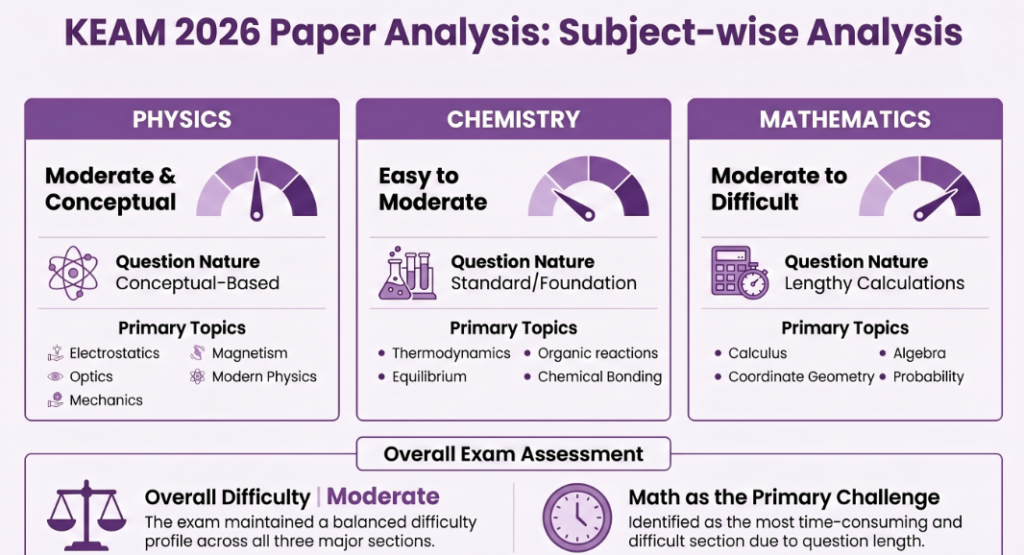
The KEAM 2026 paper analysis gives students a clear understanding of the exam difficulty level, question trends, and subject-wise weightage. Based on student reactions and expert review, the paper was overall moderate in difficulty, with each subject showing a different pattern. Mathematics was considered the most time-consuming section, while Chemistry was comparatively easier, and Physics had more concept-based questions.
| Subject | Difficulty Level | Topics Asked |
| Physics | Moderate Conceptual-Based Questions | Electrostatics, Optics, Mechanics, Magnetism, Modern Physics |
| Chemistry | Easy to Moderate | Thermodynamics, Equilibrium, Organic reactions, Bonding |
| Mathematics | Moderate to Difficult Lengthy | Calculus, Coordinate Geometry, Algebra, Probability |
| Overall Difficulty | Moderate | |
What are the Students’ Reactions of KEAM 2026 17th April Exam?
As per the students, there are very few direct questions and more tricky ones. According to student feedback, the paper had fewer straightforward questions. Many questions required deeper thinking and careful understanding. Many candidates felt that today’s KEAM 2026 exam was more difficult than last year’s paper.
- Mathematics (Most Difficult Section): Many students said Mathematics was the toughest part of the exam. The section was lengthy and had several difficult calculus-based questions.
- Physics (Moderate Difficulty): Students rated Physics as moderate. The paper included more concept-based questions compared to direct formula questions.
- Chemistry (Easy to Moderate): Chemistry was considered the easiest section by many students. Several questions were based on NCERT textbook topics.
KEAM Exam Pattern 2026
Understanding the KEAM exam pattern is essential before diving into the KEAM paper analysis. The KEAM question paper pattern underwent a significant change in 2024, moving to CBT mode and restructuring the subject distribution. The 2026 pattern continues the same structure.
| Subjects | No. of Questions | Marks Per Question | Total Marks | Weightage (%) |
| Mathematics | 75 | 4 | 300 | 50% |
| Physics | 45 | 4 | 180 | 30% |
| Chemistry | 30 | 4 | 120 | 20% |
| Total | 150 | — | 600 | 100% |
How is the KEAM Rank Calculated?
The KEAM rank analysis depends not just on entrance exam scores but also on board marks. The final rank for the KEAM result analysis is calculated using a 50:50 weightage, 50% from the KEAM entrance score and 50% from Class 12 board marks in Physics, Chemistry, and Mathematics (standardised). This is an important factor for candidates to note when estimating their KEAM paper analysis expected marks.
Final KEAM Rank = 50% (KEAM Score) + 50% (Standardised Class 12 PCM Marks)
What is KEAM 2026 Chapter-Wise Weightage?
The KEAM 2026 chapter-wise weightage is different for every subject and topic. Based on the previous year KEAM question paper analysis, some chapters from Physics, Chemistry, and Mathematics have appeared regularly in the exam. These topics are considered important as they often carry good scoring opportunities for candidates.
| Subjects | Number of Questions | Approx Weight (%) |
| Physics | 35 | ~28% |
| Chemistry | 35 | ~28% |
| Mathematics / Biology | 40 | ~32% |
| Aptitude | 10 | ~8% |
| English | 5 | ~4% |
| Total | 125 | 100% |
KEAM 2026 Answer Key and Response Sheet
The KEAM 2026 Answer Key and Response Sheet will be released by the Commissioner for Entrance Examinations (CEE), Kerala, on the official website after the exam is completed. Candidates who appeared for the entrance test can download the provisional answer key to check their responses and estimate their scores before the official result declaration.
The KEAM 2026 answer key will contain the correct answers for all sets of the question paper, while the KEAM 2026 response sheet will display the answers marked by candidates during the exam. By comparing both, students can calculate their expected marks and analyse their performance.
Check the KEAM Answer Key 2026
If candidates find any discrepancy in the provisional key, they will be allowed to raise objections within the given deadline by submitting supporting documents and the required fee. After reviewing all challenges, the exam authority will publish the final KEAM 2026 answer key, which will be used for result preparation.
Expected KEAM 2026 Marks v/s Ranks
The KEAM 2026 Marks vs Rank analysis helps candidates estimate their expected rank based on their combined KEAM score and board marks after standardisation. This expected data is based on previous year trends and can give students a rough idea of their admission chances in top colleges.
| KEAM Score (Boards + KEAM) after standardisation | KEAM 2026 Ranks expected |
| 550+ | 1 to 5000 |
| 450+ | 5001 to 20000 |
| 350+ | 20001 to 50000 |
| 250 and below | 50000+ |
How To Prepare For Upcoming KEAM Exams?
Preparing for the upcoming KEAM exams requires a smart study plan, regular practice, and strong concept clarity. Since the KEAM entrance exam tests Physics, Chemistry, and Mathematics, candidates should focus on completing the syllabus, revising important topics, and solving mock tests to improve speed and accuracy. A balanced preparation strategy can help students score well in KEAM 2026.
- Focus on High-Weightage Topics: Prepare chapters that usually carry more marks in KEAM exams, such as Calculus, Mechanics, Organic Chemistry, and Optics.
- Study NCERT Books Thoroughly: NCERT textbooks are very useful, especially for Chemistry and basic concepts in Physics.
- Solve KEAM Previous Year Question Papers: Practice KEAM previous year question papers to understand question trends and important topics.
- Attempt Mock Tests Regularly: Take online KEAM mock tests to improve speed, time management, and exam confidence. Candidates can also practice with the CollegeDost KEAM Mock Test for a real exam-like experience and better preparation.
- Revise Formulas and Short Notes: Make quick revision notes for formulas, reactions, and key concepts for last-minute preparation.
- Improve Accuracy Along With Speed: Avoid guessing answers. Focus on solving questions correctly within the given time.
- Analyse Your Mistakes: After every test, review wrong answers and work on weak chapters.
- Stay Consistent and Healthy: Maintain proper sleep, healthy food habits, and regular breaks to stay focused during KEAM preparation.
Check some of the KEAM 2026 Important Topics to Revise from the table below.
| Subject | KEAM 2026 Important Topics to Revise |
| Physics | Focus on high-weightage chapters such as Mechanics, Electrostatics, Current Electricity, Ray Optics, Wave Optics, and Modern Physics. Important topics include Work, Energy and Power, Laws of Motion, Thermodynamics, Rotational Motion, Capacitors, Electromagnetic Induction, and Semiconductor Devices. |
| Chemistry | Revise scoring topics like d & f Block Elements, Coordination Compounds, General Organic Chemistry, Electrochemistry, and Chemical Kinetics. Students should also focus on NCERT Class 11 & 12 textbooks, named reactions, and numerical problems in Physical Chemistry. |
| Mathematics | Give priority to Integral Calculus, Two-Dimensional Geometry, Vectors, 3D Geometry, and Trigonometry. Other key chapters include Matrices & Determinants, Sets, Relations & Functions, and Differential Equations for better scoring chances. |
Also Check: Practice KEAM Mock Test Series for All Subjects
Important Topics Based on Past Trends
Based on previous year patterns and KEAM exam analysis, some topics are expected to have higher weightage in KEAM 2026. Students should give extra attention to these chapters during revision.
- Physics: Electrostatics, Optics, Thermodynamics, Mechanics, Magnetism, and Modern Physics
- Chemistry: Thermodynamics, Chemical Equilibrium, Chemical Bonding, Coordination Compounds, and Organic Reactions
- Mathematics: Coordinate Geometry, Calculus, Algebra, Probability, Derivatives, and Integrals
KEAM 2026 Exam Day Guidelines
Candidates appearing for the KEAM 2026 exam should carefully follow all exam day instructions to avoid any last-minute problems. Reaching the centre on time, carrying the required documents, and following the dress code are important for a smooth entry process. Students and parents must also cooperate with venue rules for hassle-free arrangements.
- Parents should not enter the exam centre premises.
- Parents should drop off candidates and leave immediately to avoid traffic congestion.
- Parents should pick up candidates from a safe place away from the main gate after the exam.
- Parents should not gather near the exam centre entrance.
- Vehicles should not be parked in restricted areas or block traffic.
- Candidates should wear simple and comfortable clothes without extra pockets.
- Candidates should not wear jewellery, watches, or unnecessary accessories.
- Candidates should carry their KEAM 2026 admit card and a valid ID proof.
- Candidates are advised to reach the exam centre 30–45 minutes before reporting time.
- Candidates should cooperate during frisking and security checks.
- They do not carry mobile phones, calculators, or electronic gadgets.
- Candidates should stay calm and follow the invigilator’s instructions carefully.
Conclusion
The KEAM Paper Analysis 2026 for the 17th April engineering shift will help students understand paper trends, expected marks, safe score targets, and admission chances. As the exam is still ongoing, CollegeDost will continuously update this page with live student reactions, exact difficulty level, memory-based questions, and expected cut-offs. Stay tuned for the most reliable KEAM 2026 exam analysis.