Summarise With AI



According to the KEAM paper analysis April 18, the exam was average in difficulty but appeared comparatively long, and the candidates needed to have good time management skills. According to preliminary feedback, the KEAM 2026 difficulty level was not very challenging in concept, but the number of questions requiring calculations made it time-consuming. The KEAM exam pattern was the same, but the weightage of Mathematics was the highest, followed by Physics and Chemistry.
Multi-step problems made the KEAM Maths Question Paper the most difficult for the students, with Chemistry being relatively easy and easy to score. On the whole, the KEAM entrance exam was a test of conceptual fluency and speed, where accuracy was a major determinant of a good score. The trend is consistent with the past changes, where equal preparation and effective time management were instrumental in performance.
Also Check: KEAM April 17 Paper Analysis
Before Results Shock You, Predict Your KEAM Rank Now! Get an early idea of rank and make informed college decisions.

KEAM Paper Analysis 2026 Highlights
Check out the KEAM paper analysis overview below:
| Particulars | Details |
|---|---|
| Exam Name | KEAM entrance exam |
| Exam Date | April 18, 2026 |
| Overall Difficulty | Moderate to slightly lengthy |
| Mathematics Difficulty | Moderate to tough (most time-consuming) |
| Physics Difficulty | Moderate |
| Chemistry Difficulty | Easy to moderate (scoring) |
| Total Questions | 150 |
| Marking Scheme | +4 for correct, -1 for incorrect |
| Good Attempts | 95 to 115 questions |
| Expected Score Range | 350 to 450 marks |
| Key Highlights | Calculation-heavy Maths, balanced Physics, easy Chemistry |
| Time Management | Crucial for maximising attempts |
Subject-wise KEAM Paper Analysis
The subject-wise paper analysis of the KEAM test dated April 18 indicates an even spread of toughness in all three sections, with a considerable variance in efforts and time spent on them. Though all subjects adhered to their respective syllabus and KEAM exam patterns, the complexity and application level varied. The maximum amount of time was required in mathematics owing to calculations, while Physics remained moderate in both aspects.
| Subject | Difficulty Level | Key Topics Asked | Student Feedback |
|---|---|---|---|
| Mathematics | Moderate to Tough | Calculus, Algebra, Coordinate Geometry | Most time-consuming section |
| Physics | Moderate | Mechanics, Thermodynamics, Modern Physics | Balanced but required accuracy |
| Chemistry | Easy to Moderate | Organic, Inorganic, Physical Chemistry | The easiest and scoring section |
Key Takeaways from Today’s KEAM Paper Analysis April 18
Check the overall KEAM paper analysis below:
- The analysis of the KEAM paper April 18 analysis shows a moderate but long paper.
- The KEAM difficulty level was not very demanding, but it demanded effective time management.
- The most challenging and time-consuming part was mathematics.
- Physics had a moderate combination of conceptual and numerical problems.
- The simplest and the most scoring section of the paper was chemistry.
- The pattern of the KEAM examination was comparable to the past changes.
- Bad marking meant that accuracy was an important factor.
- Students who were oriented towards speed and question choice did better.
- The general practice and time allocation were relied upon to enhance performance.
KEAM Answer Key 2026
The Commissioner of Entrance Examinations (CEE), Kerala, will release the KEAM 2026 response sheet and answer key on its official site after the test is finished. Those who have taken the exam will be allowed to download the provisional answer key to match their answers and approximate their likely results prior to the announcement of the results.
The correct answers to all the question paper sets will be given in the answer key, and the answers that the candidates will have indicated during the examination will be given on the response sheet. Cross-checking the two documents will enable students to have a good picture of their performance and the estimated marks. Till then, students can check the unofficial answer key based on the KEAM memory-based questions below:
KEAM Exam Pattern 2026
Students appearing for the upcoming KEAM session must check the KEAM exam pattern 2026 carefully.
| Parameter | Details |
|---|---|
| Exam Name | KEAM 2026 (Kerala Engineering Architecture Medical Entrance Exam) |
| Mode of Exam | Pen & Paper (Offline) |
| Subjects | Physics, Chemistry, Mathematics |
| Number of Papers | 2 (Paper 1: Physics & Chemistry, Paper 2: Mathematics) |
| Type of Questions | Multiple Choice Questions (MCQs) |
| Number of Questions | Physics & Chemistry: 120 (60 each), Mathematics: 60 |
| Marks per Question | 4 marks |
| Negative Marking | None |
| Total Marks | 480 (Physics & Chemistry: 240, Mathematics: 240) |
| Duration | 2 hours 30 minutes per paper |
| Syllabus | As per the KEAM 2026 syllabus (Physics, Chemistry, Mathematics) |
| Medium of Exam | English / Malayalam |
| Qualifying Criteria | Rank based on the combined score of Paper 1 & Paper 2 |
KEAM 2026 Exam Day Guidelines
Refer to the following to know all the KEAM exam day instructions:
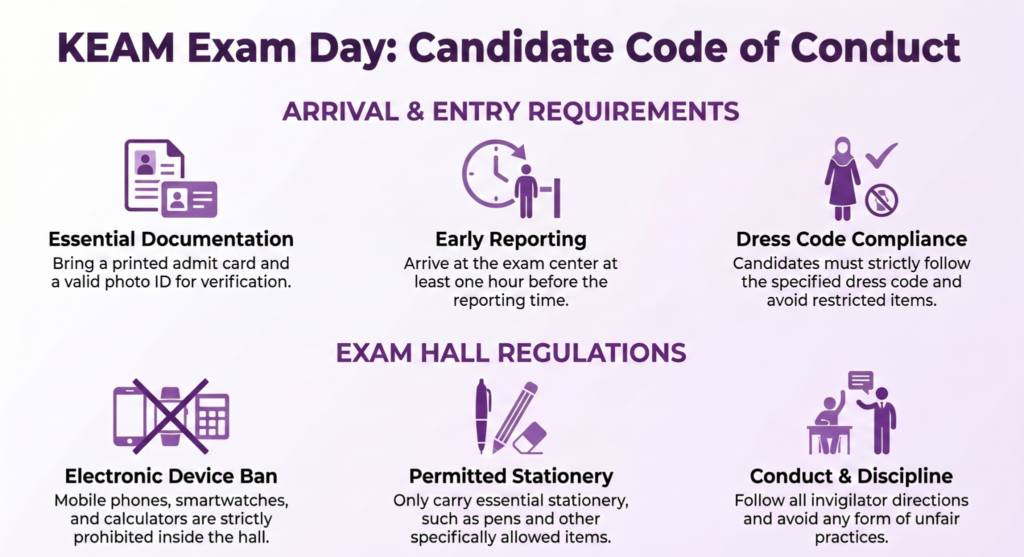
- Bring a printout of the KEAM admit card and a valid photo ID verification.
- Report to the exam centre at least 1 hour before the reporting time.
- Wear according to the dress code and do not wear restricted items.
- Do not carry electronic devices such as mobile phones, smart watches or calculators.
- Only bring essential stationery (pens and other allowed things).
- Take all directions from the invigilators in the exam hall.
- Stay disciplined and avoid any form of unfair practices in the exam.
- Ensure proper handling of the OMR sheet to avoid mistakes
- Use time effectively in every part of the paper.
- Be calm and concentrated during the KEAM entrance exam.
- Do not leave the exam hall before the allowed exit time
- Review carefully and then hand in the answer sheet.
KEAM 2026 Important Topics
The difficulty level of KEAM 2026, according to trends and division of syllabus analysis, is moderate, and speed, accuracy, and concept applicability are the major areas that need emphasis. The important topics are mentioned below:
| Subject | High Weightage Topics |
|---|---|
| Mathematics | Calculus (limits, derivatives, integration), Algebra (complex numbers, quadratic equations, matrices & determinants), Trigonometry & inverse trigonometric functions, |
| Physics | Laws of motion, work, energy & power, Electrostatics & current electricity, Magnetism & electromagnetic induction, Optics (mirrors & lenses), Modern physics & semiconductors |
| Chemistry | Chemical bonding & molecular structure, Thermodynamics & equilibrium, Organic chemistry basics & hydrocarbons, Periodic table & inorganic chemistry trends |
Top Colleges Accepting KEAM
Check out the top colleges accepting KEAM scores below:
| College Name | Type | Location |
|---|---|---|
| College of Engineering, Trivandrum | Government | Thiruvananthapuram |
| Government Engineering College, Thrissur | Government | Thrissur |
| Government Engineering College, Kozhikode | Government | Kozhikode |
| Rajiv Gandhi Institute of Technology | Government-Aided | Kottayam |
| TKM College of Engineering | Government-Aided | Kollam |
| Government Engineering College, Barton Hill | Government | Thiruvananthapuram |
| Mar Athanasius College of Engineering | Government-Aided | Kothamangalam |
| NSS College of Engineering | Government-Aided | Palakkad |
| Model Engineering College | Government-Aided | Kochi |
| Rajagiri School of Engineering & Technology | Private | Kochi |
| SCMS School of Engineering & Technology | Private | Ernakulam |
| Saintgits College of Engineering | Private | Kottayam |
Conclusion
The KEAM paper analysis conducted on April 18 clearly indicates that the level of challenge for this time frame was not a matter of how difficult the questions were, but rather how well you executed answering the questions, given your time constraints.
Balance was critical for success in KEAM 2026, and the students who were able to come up with a good balance between the speed at which they answered the questions and accuracy most likely had the best chance of success.
With future tests, students should focus on developing better strategies for selecting problems to solve as well as developing better ways to calculate solutions rather than just reviewing concepts.