
Summarise With AI


BITSAT Exam Analysis 2026 for April 15 and 16 is now available. After going through student feedback and memory-based questions from all four shifts, here is a complete breakdown of the BITSAT Paper analysis. Overall, the paper stayed moderate across most shifts. Mathematics was the toughest section throughout. English and Logical Reasoning were the easiest and most scoring parts. If you are preparing for Session 2 in May 2026, this BITSAT 2026 exam analysis will help you plan your preparation better.
BITSAT Exam Analysis April 15 and 16, 2026: Overall Difficulty
Students who appeared across all four shifts gave mixed reactions, but a clear pattern emerged. Most said the paper was moderate, with Maths being the heaviest section. Here is the shift-wise breakdown based on student feedback and memory-based questions.
BITSAT Exam Analysis April 15 Shift 1
The April 15 Shift 1 paper was moderate to slightly tough. Physics was formula-heavy. Most questions in Chemistry were from BITSAT syllabus. Maths made the biggest difference in performance for most students.
| Section | Difficulty Level | Remarks |
|---|---|---|
| Physics | Moderate | Formula-heavy, application-based |
| Chemistry | Easy to Moderate | Concept-based, direct questions |
| Mathematics | Difficult | Lengthy, calculative |
| English Proficiency | Easy | Grammar-focused |
| Logical Reasoning | Easy to Moderate | Direct, doable |
| Overall | Moderate to Slightly Tough | Maths pulled the difficulty up |
BITSAT Exam Analysis April 15 Shift 2
Shift 2 on April 15 was harder than the morning slot. Students found all three science sections tough. The cutoff for this shift is expected to be lower than that of Shift 1.
| Section | Difficulty Level | Remarks |
|---|---|---|
| Physics | Tough | Transistors, Rotation, Gravitation |
| Chemistry | Moderate | Physical was calculative, Organic theoretical |
| Mathematics | Toughest | Calculus, Coordinate, Algebra-heavy |
| English Proficiency | Easy | Venn Diagram, doable |
| Logical Reasoning | Easy | Direct |
| Overall | Difficult | Lower cutoff expected for this shift |
BITSAT Exam Analysis April 16 Shift 1
April 16 Shift 1 was the most balanced paper of the four slots. Students reported that the paper was manageable if attempted with good speed and strategy. Maths was easier compared to JEE Mains.
| Section | Difficulty Level | Remarks |
|---|---|---|
| Physics | Moderate | Direct, formula-based, theoretical |
| Chemistry | Moderate | NCERT-based, low organic weightage |
| Mathematics | Moderate | Lengthy but manageable |
| English Proficiency | Easy | Class 10-level questions |
| Logical Reasoning | Easy to Moderate | Verbal, Chart logic |
| Overall | Moderate | Balanced and well-structured paper |
BITSAT Exam Analysis April 16 Shift 2
April 16 Shift 2 was considered the toughest shift of the entire session. Chemistry surprised many students with tricky questions. Maths was time-consuming, and Physics stayed moderate.
| Section | Difficulty Level | Remarks |
|---|---|---|
| Physics | Moderate | 35 to 40 per cent theoretical |
| Chemistry | Moderate to Difficult | Tricky, toughest section this shift |
| Mathematics | Moderate to Tough | Time-consuming |
| English Proficiency | Easy | Antonyms, Synonyms |
| Logical Reasoning | Easy | Scoring |
| Overall | Moderate to Difficult | Chemistry was the toughest section |
BITSAT Exam Analysis 2026: Subject-wise Detailed Analysis
Each subject showed a consistent pattern across shifts, with some variation in difficulty. Here is a section-by-section breakdown based on actual student reports and memory-based questions from the BITSAT question paper.
BITSAT Exam Analysis: Physics Section
Physics stayed moderate across all four shifts. The section had a mix of formula-based and theoretical questions. Around 35 to 40 per cent of questions were theory-based, and the rest were numerical. Some questions on April 15 combined concepts from two or three topics at once, which made them more time-consuming. Topics asked across shifts:
- Current Electricity and Circuits
- Kinematics and Laws of Motion
- Heat and Thermodynamics
- Carnot Engine
- Electrostatics and Capacitors
- Magnetic Effects of Current
- Modern Physics and Nuclei
- Work, Energy and Power
- SHM and Oscillations
- Gravitation, Semiconductor, Units and Dimensions
BITSAT Paper Analysis: Chemistry Section
Chemistry showed the most variation across shifts in terms of BITSAT subject wise weightage. It was easy to moderate on April 15 Shift 1, but it became the toughest section on April 16 Shift 2. The section-wise order in most shifts was Organic, followed by Inorganic, then Physical. Topics asked across shifts:
- GOC and Reactions
- Carboxylic Acids and Derivatives
- Chemical Bonding and Molecular Structure
- Chemical Thermodynamics
- Electrochemistry
- Biomolecules, Polymers, Surface Chemistry
- States of Matter, Isomerism
- Redox Reactions, Mole Concept
- S-block and P-block Elements
- Solid State, Salt Analysis
BITSAT Exam Analysis: Mathematics Section
Mathematics was the most challenging section across all four shifts of this BITSAT exam paper. Questions were lengthy and calculative. Students who managed their time well in Maths had a clear advantage. The section was still easier than JEE Mains but required strong fundamentals and quick calculation. Topics asked across shifts:
- Calculus (Integration, Differential Equations)
- Coordinate Geometry (Circles, Parabola, Conics)
- Probability and Statistics
- Vectors and 3D Geometry
- Linear Programming
- Matrices and Determinants
- Trigonometry and Complex Numbers
- Binomial Theorem, Sequence and Series
- Sets and Limits
- Permutation and Combination
BITSAT Exam Analysis: English Proficiency Section
English was the easiest and quickest section across all shifts. This is consistent with the standard BITSAT exam pattern, where English is designed to be scoring and time-efficient. Most students finished this section in under 10 minutes. Topics asked:
- Synonyms and Antonyms
- Sentence Completion and Correction
- Error Detection and Grammar
- One-word Substitution
- Reading Comprehension
- Homophones
BITSAT Exam Analysis: Logical Reasoning Section
Logical Reasoning stayed consistent with its reputation of being a scoring, manageable section across all shifts. This section follows a predictable BITSAT question paper pattern and rewards students who have practiced variety. Topics asked:
- Number Series and Letter Series
- Coding-Decoding
- Analogy
- Direction Sense
- Syllogism
- Puzzle-based questions
- Verbal and Non-verbal Reasoning
- Chart Logic
BITSAT Exam Analysis 2026: Subject-Wise Insights
Based on student reactions and memory-based questions from different shifts, BITSAT 2026 exam showed noticeable variation across Physics, Chemistry, and Mathematics. While some shifts focused on direct, formula-based questions, others tested application and concept clarity. Here is a clear subject-wise breakdown of the key observations.
BITSAT Physics Section: Observations
The Physics section changed slightly across shifts, with some papers focusing on concepts and others on formulas. Overall, it was moderate and manageable for most students.
- April 15 Shift 1: Questions were more application-based and required logical thinking
- April 16 Shift 1: Paper was more direct, with formula-based questions
- April 16 Shift 2: Around 7 questions came from Work, Energy and Power alone
- Overall Trend: Physics was more manageable compared to JEE Main
BITSAT Chemistry Section: Observations
Chemistry was mostly scoring, but a few shifts had tricky questions from different topics.
- April 16 Shift 1: Most questions were from NCERT level
- Some questions in this shift were asked from deleted chapters
- April 16 Shift 2: Paper became slightly tricky with Isomerism, Salt Analysis, and Thermodynamics combined
- Physical Chemistry had higher weightage in Shift 2 compared to other shifts
BITSAT Mathematics Section: Observations
Maths had a mixed trend. Some shifts were easier, but a few questions were still lengthy and time-consuming.
- April 15 shifts: Questions involved mixed concepts
- April 16 Shift 1: Easier compared to other shifts, but a few questions were lengthy
- April 16 Shift 2: Probability had around 6 questions, higher than usual weightage
- Students strong in calculus and probability performed better overall
BITSAT English Section: Observations
The English section was simple and scoring. Most questions were easy and could be solved quickly without much calculation.
- Questions were at Class 10 to 12 board level
- Grammar-based questions were asked the most
- A good section to score marks quickly without spending much time
BITSAT Logical Reasoning Section: Observations
The Logical Reasoning section was easy and quick to attempt in most shifts. It helped students save time and score easily.
- April 16 Shift 1: Some chart-based logic questions were slightly tricky
- April 16 Shift 2: Questions were mostly direct, including series and syllogism
- Overall Trend: Time required was low across all shifts
- One of the best sections to attempt early and score quickly
BITSAT Exam Analysis: Memory-Based Questions
These questions come from student recall after the exam. They are not official questions but closely reflect what was asked. Students preparing for Session 2 should use these as practice references to understand the type and difficulty of questions in the actual BITSAT exam analysis.
BITSAT Question Paper Pattern: Physics Memory-Based Questions
The Physics questions below were reported mainly from April 16 Shift 2. They were numerical and concept-based, requiring application of formulas from Mechanics and Thermodynamics.
Q1: An inclined plane makes an angle of 45 degrees. A circular loop rolls down with acceleration a. Write a in terms of g.
Q2: Combustion of a fuel-air mixture occurs at 3100 K and exhaust gases leave at 300 K. Calculate the efficiency of the Carnot engine.
Q3: A 2 kg particle has 1D motion with potential U(x) = x squared + x to the power 4. The particle is released from rest at x = 1 m with V(x=1) = 0. Find acceleration at x = 0.
Q4: Speed v(x) = 2x squared + 1 m/s. At x = 1 m, find the acceleration.
Q5: At sea level, water boils at Ts. At 1 km above sea level, it boils at Tm. How are Ts and Tm related?
BITSAT Question Paper Pattern: Chemistry Memory-Based Questions
These Chemistry questions were recalled from April 16 Shift 2 and covered Organic, Physical, and Inorganic areas. The mix of topics reflects the wide range seen in that shift’s BITSAT exam paper.
Q1: What is the structure of the Claisen condensation product?
Q2: Oxidation of glucose with Br2 and H2O followed by hydrolysis gives what product?
Q3: An element M transforms from BCC to CCP structure on heating. Find the ratio of density of CCP to BCC structure.
Q4: What is the molar conductivity of a strong electrolyte at low concentration?
Q5: An electron is accelerated through a potential of 900 V. Find the approximate wavelength in picometers.
BITSAT Question Paper Pattern: Mathematics Memory-Based Questions
The Maths questions from April 16 covered Probability, Statistics, Differential Equations, and Coordinate Geometry. These topics appeared repeatedly across both shifts on April 16 and should be a priority for Session 2 preparation.
Q1: If the variance of a distribution is zero, what can be said about the data?
Q2: Find the area between y = sin x and y = cos x from x = 0 to x = pi, above the x-axis.
Q3: Solve: y squared + (x minus 1/y) dy/dx = 0
Q4: P(A) = 0.5, P(B) = 0.6, P(C) = 0.4, P(A intersection B) is at least 0.3, P(B intersection C) = 0.2, P(A intersection C) = 0.1. Find P(A union B union C).
Q5: Matrix A is [100010321] in 3×3 form. Find A raised to the power 100.
BITSAT Exam Pattern and Paper Pattern
BITSAT follows a fixed exam pattern. The total duration is 3 hours with a set number of questions in each section. After attempting all 130 questions, you can try 12 bonus questions. These include 4 questions each from Physics, Chemistry, and Mathematics or Biology. Many students skip them due to time pressure. If you manage your time well, these questions can help increase your score.
| Detail | Info |
|---|---|
| Mode | Computer-Based Test |
| Duration | 3 Hours |
| Total Questions | 130 MCQs plus 12 Bonus |
| Marking | +3 correct, minus 1 wrong, 0 unanswered |
| Bonus Questions | 12 extra questions unlocked only after all 130 are attempted |
BITSAT Total Marks: What Is the Maximum Score?
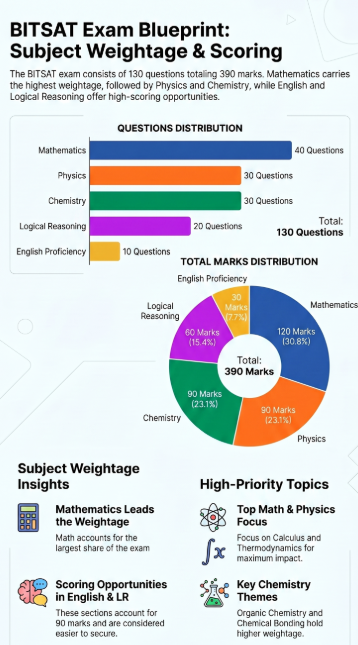
A lot of students search for BITSAT total marks before and after the exam to understand where they stand. The total marks in BITSAT are 390 for the 130 mandatory questions. If you attempt all 12 bonus questions correctly, the maximum possible score goes up to 426. Here is a quick breakdown:
| Component | Questions | Marks per Question | Total |
|---|---|---|---|
| Main Paper | 130 | 3 | 390 |
| Bonus Questions | 12 | 3 | 36 |
| Maximum Possible | 142 | 3 | 426 |
BITSAT Subject Wise Weightage
Knowing the BITSAT subject wise weightage helps in planning how much time and effort to give to each section. Mathematics carries the highest marks, followed equally by Physics and Chemistry. English and LR together account for 90 marks, which are relatively easy to secure. Based on the April 2026 BITSAT paper, the chapter-wise weightage looked like this:
- Physics: Work, Energy and Power; Heat and Thermodynamics; Current Electricity had the most questions
- Chemistry: Organic Chemistry, Thermodynamics, and Chemical Bonding had higher weightage
- Mathematics: Probability, Calculus, and Linear Programming had the most questions
BITSAT Marks vs Score Analysis
Your raw score and rank in BITSAT depend on the shift you appeared in, since moderated scores adjust for difficulty variation. Here is a general marks versus performance range based on the April 2026 paper trends:
| Score Range | Performance Level |
|---|---|
| 300 and above | Excellent, strong chance at top branches across all campuses |
| 260 to 299 | Good, eligible for most programs at Pilani, Goa, and Hyderabad |
| 220 to 259 | Average, competitive for select branches at Goa and Hyderabad |
| Below 220 | Needs improvement, options become limited |
Safe Score for BITSAT 2026
The safe score for BITSAT 2026 depends on which campus and branch you are targeting. Based on the April 2026 difficulty level and historical trends, here are the estimated safe score ranges.
- BITS Pilani (top branches like CSE and ECE): 310 to 330 and above
- BITS Goa (core branches): 280 to 300
- BITS Hyderabad (most branches): 270 to 290
Students targeting Pilani should aim for at least 300 or above. April 15 Shift 2 was the toughest, so the effective cutoff for that slot is expected to be lower than other shifts.
BITSAT Result 2026: When and How to Check
BITSAT result process works in two stages. On the day of the exam, your raw score is displayed on the screen immediately after you finish. You must note this number before exiting the hall since it is your provisional score. After both Session 1 and Session 2 are complete, BITS Pilani releases the official moderated scores. These are adjusted for difficulty variation across shifts and are used for the final merit list. BITSAT result is expected to be released in the first week of June after Session 2 concludes in May 2026.
How to check the BITSAT result 2026?
- Visit the official BITS Pilani admissions portal
- Log in using your application number and password
- Go to the results section on your dashboard
- Your moderated score and rank will be displayed
- Download and save your scorecard for future reference
BITSAT Cutoffs 2026
Looking at past cutoffs helps in setting a target score. In 2025, the cutoff was around 305 for BITS Pilani, 274 for BITS Goa, and 270 for BITS Hyderabad. Cutoffs change every year based on factors like the number of students, available seats, exam difficulty, and past trends.
| Campus | BITSAT 2025 Cutoff | Expected Cutoff 2026 |
|---|---|---|
| BITS Pilani | Around 305 | 335 – 340 |
| BITS Goa | Around 274 | 315 – 320 |
| BITS Hyderabad | Around 270 | 310 – 315 |
BITSAT Previous Year Papers and Sample Papers
Practicing BITSAT previous year papers and BITSAT sample papers is one of the most practical ways to prepare for Session 2. BITSAT model test papers give you a real sense of the paper’s pace, format, and question style before you walk into the exam hall.
Why is it important to solve BITSAT previous papers?
- Understand the actual difficulty level
- Identify high-weightage chapters
- Build speed and accuracy for the CBT format
- Get familiar with the bonus question system
How to Check BITSAT Score After Exam?
BITS Pilani does not release an official public answer key, but you can still check your score easily using the steps below:
- After completing the exam, your score is shown on the screen
- Note it down before leaving the exam hall, as this is your provisional score
- After all shifts are over, BITS Pilani releases moderated scores
- These scores are adjusted based on difficulty across shifts and used for the final merit list
- To calculate your score yourself:
- Add 3 marks for every correct answer
- Subtract 1 mark for every wrong answer
- Unanswered questions carry 0 marks
- The maximum score is 390
- You can also refer to memory-based answer keys released by coaching institutes within 24 to 48 hours
- These are not official, but they help you estimate your score
BITSAT Absentee Slot Booking 2026
BITS Pilani has opened an absentee slot for candidates who could not appear for their scheduled BITSAT 2026 Session 1 exam. The absentee test is scheduled for April 19, 2026, at selected exam centres. The slot booking BITSAT window has opened from April 16 (11 AM) to April 17 (2 PM). Candidates need to complete the booking process within this time through the official website.
How to Register for BITSAT Absentee Slot?
You can follow these simple steps to book your absentee slot:
- Visit the official website: admissions.bits-pilani.ac.in
- Click on the BITSAT 2026 Session 1 Absentee Slot Booking link
- Log in using your application number and password
- Select and confirm your exam slot for April 19
How to Prepare for BITSAT Session 2?
After checking student feedback and memory-based questions from the April shifts, a clear pattern can be seen. Preparation should be based on what was actually asked in the exam.
- Start with high-weightage topics. Physics had more questions from Work, Energy and Power, Thermodynamics, and Current Electricity. Chemistry focused on Organic Chemistry, Chemical Bonding, and Thermodynamics. Maths had more questions from Probability, Calculus, and Linear Programming.
- Use English and Logical Reasoning to score marks quickly. Questions were direct and took less time. Grammar, vocabulary, series, and syllogism were common. This section can be attempted early.
- Be careful with time in Mathematics. Questions were lengthy in most shifts. Practice with a timer and avoid spending too long on one question. Focus more on calculus and probability.
- Prepare Physics in a mixed way. Some shifts had direct formula-based questions, while others needed more thinking. Revise formulas and practice application-based questions.
- Keep Chemistry simple and NCERT-focused. Most questions were direct, but a few were tricky. Focus on Organic reactions, Inorganic facts, and Physical Chemistry.
- Use bonus questions only if time is left. You get 12 extra questions after attempting all 130. They can help improve your score if attempted carefully.
- Practice full-length mock tests regularly. Follow the 3-hour format. Analyse mistakes and improve speed with accuracy.
- Keep a clear target in mind. A score of 300+ is safe. 320+ improves chances. 330+ can help in getting top branches.
Conclusion
BITSAT 2026 April session was moderate overall, with Maths being the most demanding section across all four shifts. Chemistry on April 16 Shift 2 stood out as the toughest section of the entire session. English and Logical Reasoning remained easy and scoring, as always.
If you are appearing for BITSAT exam date Session 2 scheduled from May 24 to 26, focus on Calculus, Probability, Organic Chemistry, and Thermodynamics. Practice regularly using BITSAT previous papers and attempt at least three to four full-length BITSAT model test papers before your exam date.