Summarise With AI


Table of Contents
KCET Syllabus 2026 is available on the official website at cetonline.karnataka.gov.in. The Syllabus consists of four major subjects, i.e., Physics, Chemistry, Mathematics (for Engineering aspirants, and Biology (for Medical-related courses). Each subject form KCET Exam Syllabus carries equal weightage. It means candidates must prepare each subject with equal care. Hence, it’s important for the candidates to understand the syllabus and chapter weightage properly for better preparation. This article provides the complete KCET syllabus 2026, including subject-wise weightage analysis. Let’s begin.
KCET Syllabus 2026: Overview
KEA prescribes KCET Syllabus based on the 1st & 2nd PUC Syllabus. For more details related to KCET Syllabus 2026, candidates can refer to the table below:
| Particular | Details |
|---|---|
| Exam Name | Karnataka Common Entrance Test |
| Conducting Body | Karnataka Examinations Authority (KEA) |
| Mode of Exam | Offline (OMR-Based) |
| Subjects | Physics, Chemistry, Maths / Biology |
| Syllabus Basis | 1st & 2nd PUC Karnataka Board |
| Level | PUC Standard |
KCET Syllabus 2026 PDF Download
Candidates looking for KCET Syllabus pdf can download it from the section below. Let’s have a look:
KCET Syllabus 2026: A Detailed Breakdown
KCET exam covers four main subjects: Physics, Chemistry, Mathematics, and Biology. Engineering aspirants have to prepare Physics, Chemistry, and Mathematics, while candidates applying for pharmacy, agriculture, veterinary, and other allied courses must prepare Biology instead of Mathematics. A detailed breakdown of KCET Syllabus 2026 has been shared below:
KCET Physics Syllabus 2026
KCET physics syllabus covers important topics from Physical World, Electric Charges and Fields, Units and Measurements, Electrostatic Potential and Capacitance, Motion in a Straight Line, Current Electricity, etc. All the chapters from KCET Exam Syllabus for Physics have been shared below:
| First-Year PUC (Class 11) Physics Syllabus | Second-Year PUC (Class 12) Physics Syllabus |
|---|---|
| Physical World | Electric Charges and Fields |
| Units and Measurements | Electrostatic Potential and Capacitance |
| Motion in a Straight Line | Current Electricity |
| Motion in a Plane | Moving Charges and Magnetism |
| Laws of Motion | Magnetism and Matter |
| Work, Energy, and Power | Electromagnetic Induction |
| System of Particles and Rotational Motion | Alternating Current |
| Gravitation | Electromagnetic Waves |
| Mechanical Properties of Solids | Ray Optics and Optical Instruments |
| Mechanical Properties of Fluids | Wave Optics |
| Thermal Properties of Matter | Dual Nature of Radiation and Matter |
| Thermodynamics | Atoms |
| Kinetic Theory of Gases | Nuclei |
KCET Chemistry Syllabus 2026
KCET Chemistry syllabus is divided into Physical, Organic, and Inorganic Chemistry. Organic Chemistry from the second-year PUC generally contributes a significant number of questions. For more details on KCET Chemistry Syllabus, you can refer to the table below:
| First-Year PUC (Class 11) | Second-Year PUC (Class 12) |
|---|---|
| Some Basic Concepts of Chemistry | Solid State |
| Structure of an Atom | Solutions |
| Classification of Elements and Periodicity in Properties | Electrochemistry |
| Chemical Bonding and Molecular Structure | Chemical Kinetics |
| States of Matter: Gases and Liquids | Surface Chemistry |
| Thermodynamics | General Principles and Processes of Isolation of Elements |
| Equilibrium | p-Block Elements |
| Redox Reactions | d- and f-Block Elements |
| Hydrogen | Coordination Compounds |
| s-Block Elements | Haloalkanes and Haloarenes |
| Some p-Block Elements | Alcohols, Phenols, and Ethers |
| Organic Chemistry: Some Basic Principles and Techniques | Aldehydes, Ketones, and Carboxylic Acids |
| Hydrocarbons | Organic Compounds Containing Nitrogen |
| Environmental Chemistry | Biomolecules |
| Polymers | – |
| Chemistry in Everyday Life | – |
KCET Maths Syllabus 2026
KCET Maths syllabus includes chapters on Matrices, Straight Lines, and Mathematical Reasoning
Probability, etc. All the chapters from PUC 1 and PUC 2 have been collated below:
| First-Year PUC | Second-Year PUC |
|---|---|
| Sets, Relations, and Functions | Relations and Functions |
| Trigonometric Functions | Inverse Trigonometric Functions |
| Principle of Mathematical Induction | Matrices |
| Complex Numbers and Quadratic Equations | Determinants |
| Linear Inequalities | Continuity and Differentiability |
| Permutations and Combinations | Applications of Derivatives |
| Binomial Theorem | Integrals |
| Sequences and Series | Applications of Integrals |
| Straight Lines | Differential Equations |
| Conic Sections | Vector Algebra |
| Introduction to Three-Dimensional Geometry | Three-Dimensional Geometry |
| Limits and Derivatives | Linear Programming |
| Mathematical Reasoning | Probability |
KCET Biology Syllabus 2026
KCET Biology syllabus is important for candidates applying for pharmacy, agriculture, veterinary, and allied courses. A detailed analysis of KCET Syllabus 2026 for Biology has been shared below:
| Biology Topics | Biology Topics |
|---|---|
| The Living World | Animal Kingdom |
| Biological Classification | Structural Organisation in Animals |
| Plant Kingdom | Body Fluids and Circulation |
| Cell Cycle and Cell Division | Chemical Coordination and Integration |
| Morphology of Flowering Plants | Neural Control and Coordination |
| Locomotion and Movement | Breathing and Exchange of Gases |
| Anatomy of Flowering Plants | Mineral Nutrition |
| Excretory Products and Their Elimination | Transport in Plants |
| Cell – The Unit of Life | Respiration in Plants |
| Biomolecules | Digestion and Absorption |
| Photosynthesis in Higher Plants | Plant Growth and Development |
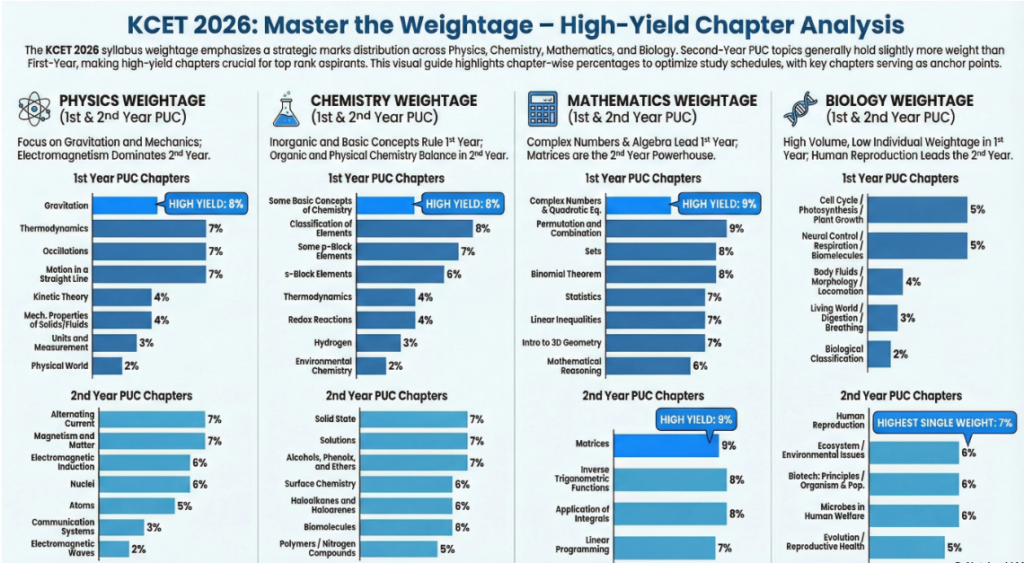
KCET Syllabus Weightage 2026: Chapter-Wise Weightage
As per KCET Syllabus weightage, Second-Year PUC topics carry slightly more weight. A detailed breakdown of KCET Syllabus Weightage 2026 has been shared below:
KCET Physics Chapter Wise Weightage
In First-Year PUC, Gravitation, Thermodynamics, Oscillations, and Motion in a Straight Line from KCET Physics syllabus carry higher weightage. In Second-Year PUC, chapters like Alternating Current Magnetism and Matter, and Electromagnetic Induction are significant contributors. The detailed chapter-wise distribution is given below.
| Chapters | Weightage |
|---|---|
| Chapter-Wise Weightage for First-Year PUC Physics Syllabus | |
| Physical-world | 2% |
| Units and measurement | 3% |
| Kinetic theory | 4% |
| Mechanical properties of solids | 4% |
| Mechanical properties of fluids | 4% |
| Motion in a straight line | 7% |
| Oscillations | 7% |
| Thermodynamics | 7% |
| Gravitation | 8% |
| Chapter-Wise Weightage for Second-Year PUC Physics Syllabus | |
| Electromagnetic Waves | 2% |
| Communication Systems | 3% |
| Atoms | 5% |
| Nuclei | 6% |
| Electromagnetic Induction | 6% |
| Magnetism and Matter | 7% |
| Alternating Current | 7% |
KCET Chemistry Chapter-Wise Weightage
Some Basic Concepts of Chemistry (8%) and Classification of Elements (8%) have the highest weightage from the First Year PUC Syllabus. Some p-Block Elements (7%) and s-Block Elements (6%) are also important. In Second-Year PUC, Solid State, Solutions, and Alcohols, Phenols and Ethers (7% each) are among the top-scoring chapters. Coordination Compounds and Surface Chemistry (6%) also contribute regularly. The complete KCET Chemistry Chapter-Wise Weightage is listed below:
| Chapter-Wise Weightage for First-Year PUC Chemistry Syllabus | |
| Chapters | Weightage |
| Environmental chemistry | 2 |
| Hydrogen | 3 |
| Redox reactions | 4 |
| Thermodynamics | 4 |
| s – Block Elements | 6% |
| Some p – Block Elements | 7% |
| Classification of Elements and Periodicity in Properties | 8% |
| Some Basic Concepts of Chemistry | 8% |
| Chapter-Wise Weightage for Second-Year PUC Chemistry Syllabus | |
| Chemistry in Everyday Life | 4% |
| General Principles and Processes of Isolation of Elements | 4% |
| Polymers | 5% |
| Organic Compounds Containing Nitrogen | 5% |
| Biomolecules | 6% |
| Surface chemistry | 6% |
| Haloalkanes and Haloarenes | 6% |
| Coordination Compounds | 6% |
| Solid State | 7% |
| Solutions | 7% |
| Alcohols, Phenols, and Ethers | 7% |
KCET Mathematics Chapter Wise Weightage
Maths is one of the most scoring sections in KCET. In First-Year PUC, Permutation and Combination (9%) and Complex Numbers (9%) have the highest weightage. Binomial Theorem and Sets (8% each) are also important. From Second-Year PUC, Matrices (9%) carry the highest marks. For KCET Mathematics Chapter-Wise Weightage, you can refer to the table below:
| Chapters | Weightage |
| Chapter-Wise Weightage for First-Year PUC Mathematics Syllabus | |
| Principle Of Mathematical Induction | 5% |
| Mathematical Reasoning | 6% |
| Introduction to 3D Geometry | 7% |
| Linear Inequalities | 7% |
| Statistics | 7% |
| Binomial Theorem | 8% |
| Sets | 8% |
| Permutation And Combination | 9% |
| Complex Numbers And Quadratic Equations | 9% |
| Chapter-Wise Weightage for Second-Year PUC Mathematics Syllabus | |
| Linear Programming | 7% |
| Application Of Integrals | 8% |
| Inverse Trigonometric Functions | 8% |
| Matrices | 9% |
KCET Biology Chapter Wise Weightage
In First-Year PUC, many chapters from Biology carry the same 5% weightage, such as Cell Cycle and Cell Division, Biomolecules, Photosynthesis, Plant Growth and Development, and Neural Control and Coordination. In Second-Year PUC, Human Reproduction (7%) has the highest weightage. Chapters like Ecosystem, Environmental Issues, Biotechnology (Principles and Processes), and Organism and Population (6% each) also carry good marks. The detailed chapter-wise weightage is given below
| Chapters | Weightage |
| Chapter-Wise Weightage for First-Year PUC Biology Syllabus | |
| Biological Classification | 2% |
| Digestion and Absorption | 3% |
| Living World | 3% |
| Breathing and Exchange of Gases | 3% |
| Excretory Products and their Elimination | 3% |
| Body fluids and Circulation | 4% |
| Morphology of Flowering Plants | 4% |
| Locomotion and Movement | 4% |
| Anatomy and Flowering Plants | 4% |
| Cell Cycle and Cell Division | 5% |
| Plant Kingdom | 5% |
| Biomolecules | 5% |
| Plant Growth and Development | 5% |
| Respiration in Plants | 5% |
| Photosynthesis in Higher Plants | 5% |
| Neural Control and Coordination | 5% |
| Chapter-Wise Weightage for Second-Year PUC Biology Syllabus | |
| Biodiversity and Conservation | 4% |
| Biotech: Application | 5% |
| Reproductive Health | 5% |
| Evolution | 5% |
| Reproduction in Organisms | 5% |
| Environmental Issues | 6% |
| Biotech: Principles and Processes | 6% |
| Organism and Population | 6% |
| Ecosystem | 6% |
| Microbes in Human Welfare | 6% |
| Human Reproduction | 7% |
KCET Exam Pattern 2026
Students applying for KCET Exam 2026 must be aware of the exam pattern as well. To get more details related to KCET Exam Pattern 2026, you can refer to the table below:
| Particulars | Details |
|---|---|
| Exam Name | Karnataka Common Entrance Test (KCET) 2026 |
| Conducting Body | Karnataka Examinations Authority (KEA) |
| Mode of Exam | Offline (Centre-Based, OMR Sheet) |
| Question Type | Multiple Choice Questions (MCQs) |
| Subjects | Physics, Chemistry, Mathematics / Biology |
| Kannada Language Paper | 50 questions (Only for specific candidates) |
| Number of Questions (Per Subject) | 60 Questions |
| Total Questions (PCM/PCB) | 180 Questions |
| Questions in Kannada Paper | 50 Questions |
| Duration (Per Subject) | 80 Minutes |
| Duration – Kannada Paper | 60 Minutes |
| Total Marks (PCM/PCB) | 180 Marks |
| Marks Per Question | 1 Mark |
| Negative Marking | No Negative Marking |
| Medium of Question Paper | English / Kannada |
Also Check: KCET Registration 2026
KCET Exam Syllabus 2026 vs KCET Syllabus 2025: Deleted Syllabus
KCET syllabus 2026 is going to remain unchanged. The Karnataka Examination Authority revised KCET Syllabus 2025. The table below provides a subject-wise breakdown of the deleted topics from Physics, Chemistry, Mathematics, and Biology.
| KCET Deleted Syllabus Physics | |
| Subject | Deleted Portion |
| Physics | Physics- Scope and excitement |
| Physics- Technology and society | |
| Nature of physical laws | |
| NIL | |
| Frame of reference: Position-time graph, speed and velocity | |
| NIL | |
| Intuitive concept of forces | |
| Inertia | |
| Newton’s first law of motion, momentum | |
| Newton’s second law of motion, the impulse | |
| Newton’s third law of motion | |
| NIL | |
| Statement of the parallel and perpendicular axes theorem and its applications | |
| Kepler’s law of planetary motion | |
| Acceleration due to gravity | |
| Elastic behavior | |
| Shear modulus of rigidity | |
| Poisson’s ratio | |
| KCET Chemistry Deleted Syllabus | |
| Chemistry | Nature of matter |
| Laws of Chemical Combination | |
| Dalton’s atomic theory | |
| Discovery of subatomic particles | |
| Atomic models | |
| Significance of classification: A brief history of the development of the periodic table | |
| Liquefaction of gases | |
| Critical temperature | |
| Kinetic energy and molecular speed | |
| Liquid state-vapour pressure | |
| Viscosity and Surface tension (qualitative idea only, no mathematical derivations) | |
| Heat capacity and specific heat capacity | |
| Criteria for equilibrium | |
| Hydrolysis of salts (elementary idea) | |
| Henderson equation | |
| Applications of redox reaction | |
| KCET Mathematics Deleted Syllabus | |
| Sets | Difference of sets |
| Complement and properties of sets | |
| Relation and Functions | RxRxR |
| Sum, Difference, Product and Quotients of functions | |
| Trigonometric functions | The general solution of trigonometric equations of the type: sin y = sin a, cos y = cos a and tan y = tan a |
| Principle of Mathematical Induction | NIL |
| Complex numbers and the Quadratic equation | Polar representation of complex numbers. |
| The square root of a complex number | |
| Linear inequalities | NIL |
| KCET Biology Deleted Syllabus | |
| The living world | Taxonomy and systematics |
| Tools to study Taxonomy | |
| Biological classification | NIL |
| Plant Kingdom | Angiosperm – classification up to class, characteristics, features and examples |
| Animal Kingdom | NIL |
| Morphology of flowering plants | Morphology and modification: Morphology of different parts of flowering plants – root, stem, leaf, fruit and seed |
| Description of families – Fabaceae | |
| Anatomy of flowering plants | Anatomy and functions of different tissues and tissue systems in dicots and monocots, secondary growth |
KCET Preparation 2026
Proper KCET preparation requires more than just completing the syllabus. Since the exam is based on the Karnataka PUC curriculum, many students assume it is simple. However, competition is high, and even small mistakes can affect your rank significantly. Hence, adopting a proper strategy during KCET Preparation is important. Let’s take a look:
Stage 1: Build Concept
The first step in preparation is completing the KCET syllabus 2026 with a full understanding. Most questions in KCET are direct, but they require conceptual clarity. Memorising without understanding can lead to mistakes.
You should begin with high-weightage chapters such as:
- Mathematics: Matrices, Probability, Permutation and Combination
- Physics: Gravitation, Thermodynamics, Alternating Current
- Chemistry: Solid State, Solutions, Coordination Compounds
- Biology: Human Reproduction, Ecosystem, Photosynthesis
While studying:
- Read directly from PUC textbooks.
- Solve MCQs after completing each chapter.
- Prepare short notes for formulas and important reactions.
This phase usually takes around 45–60 days, depending on your preparation level.
Stage 2: Solve KCET Question Papers
After completing most of the syllabus, the next crucial step in KCET preparation is solving previous year KCET question papers.
Why KCET Question Papers Are Important
Solving previous year papers helps you:
- Understand the real exam pattern
- Identify frequently asked chapters
- Improve time management
- Reduce exam fear
Many chapters, such as Gravitation, Matrices, Coordination Compounds, and Human Reproduction, are regularly asked. By solving multiple papers, you will clearly notice these trends.
How to Use KCET Question Papers Effectively
Follow a proper method instead of solving casually:
- Set a timer for 60 minutes per subject.
- Attempt the paper without checking answers midway.
- Analyse each mistake carefully after completion.
- Note whether the error was due to concept confusion, calculation error, or lack of time.
Solving at least 10–15 years of kcet question papers can greatly improve your accuracy and confidence.
Stage 3: Attempt KCET Mock Test Regularly
Once you are comfortable with the previous papers, start attempting the full-length KCET Mock Test.
How Many Mock Tests Should You Attempt?
- Minimum: 15 full-length mock tests
- Ideal: 20–30 mock tests
How to Analyse Mock Tests Properly
After every mock test:
- Calculate your accuracy percentage.
- Identify weak chapters.
- Track time spent on each section.
- Revise mistakes immediately.
Improvement from one mock test to the next is more important than the score of a single test.
60-Day KCET Preparation Plan
If you have two months before the exam, you can follow this structure:
First 30 Days
- Complete high-weightage chapters.
- Revise regularly.
- Start solving subject-wise kcet question papers.
Next 20 Days
- Finish the remaining chapters.
- Attempt 8–10 full KCET Mock Test.
- Focus on weak areas.
Last 10 Days
- Do not start new topics.
- Revise formulas and important concepts daily.
- Attempt 4–5 final mock tests in exam-like conditions.
Conclusion
The KCET Syllabus 2026 is based on the 1st and 2nd PUC syllabi and includes Physics, Chemistry, Mathematics, and Biology. Each subject carries 60 marks, and there is no negative marking in the exam. While some second-year chapters like Gravitation, Matrices, Solid State, and Human Reproduction carry slightly higher weightage, marks are spread across many topics. Since the total paper is for 180 marks, students should focus on completing the full syllabus. Solving KCET question papers and attempting mock tests regularly can help improve speed and accuracy.
Frequently Asked Questions
1. Is KCET only based on the 12th syllabus?
No, KCET is not based only on the 12th syllabus. The exam includes topics from both First-Year (Class 11) and Second-Year (Class 12) PUC syllabus prescribed by the Karnataka Board. While second-year chapters may carry slightly higher weightage, students must prepare the complete PUC syllabus.
2. Is KCET only MCQ based?
Yes, KCET is completely MCQ based. All questions are multiple-choice type, and candidates have to mark their answers on an OMR sheet. Each correct answer carries one mark, and there is no negative marking in the exam.
3. Is KCET syllabus the same as JEE?
The KCET syllabus is not the same as JEE. KCET follows the Karnataka PUC syllabus, whereas JEE follows the national NCERT syllabus and has a higher difficulty level. However, many core topics such as Mechanics, Calculus, Organic Chemistry, and Modern Physics overlap in both exams.
4. What is the KCET syllabus 2026 weightage?
The KCET syllabus 2026 weightage is distributed across both Class 11 and Class 12 chapters. In Physics, chapters like Gravitation and Alternating Current carry higher marks. In Chemistry, Solid State and Solutions are important. In Mathematics, Matrices and Probability have good weightage. In Biology, Human Reproduction and Ecosystem are among the higher-scoring chapters. Overall, the marks are spread across many units rather than concentrated in just a few.
5. Can I write both Biology and Mathematics in KCET?
Yes, eligible candidates can appear for both Mathematics and Biology papers in KCET. This option is useful for students who want flexibility in choosing engineering as well as pharmacy or agriculture courses. However, students must check the official eligibility criteria before selecting both subjects.
6. What rank can I expect if I score around 70% in KCET?
A 70% score in KCET usually indicates an average to good performance. The exact rank depends on factors such as the total number of candidates, difficulty level of the exam, and overall competition in that year. Generally, such a score may place a candidate in a mid-range rank bracket, but exact ranks vary each year.
7. Is KCET syllabus weightage evenly distributed?
The KCET syllabus weightage is relatively balanced across subjects. While some chapters carry slightly more marks, no single chapter dominates the entire paper. This means students should focus on completing the full syllabus rather than preparing only select topics.