Summarise With AI


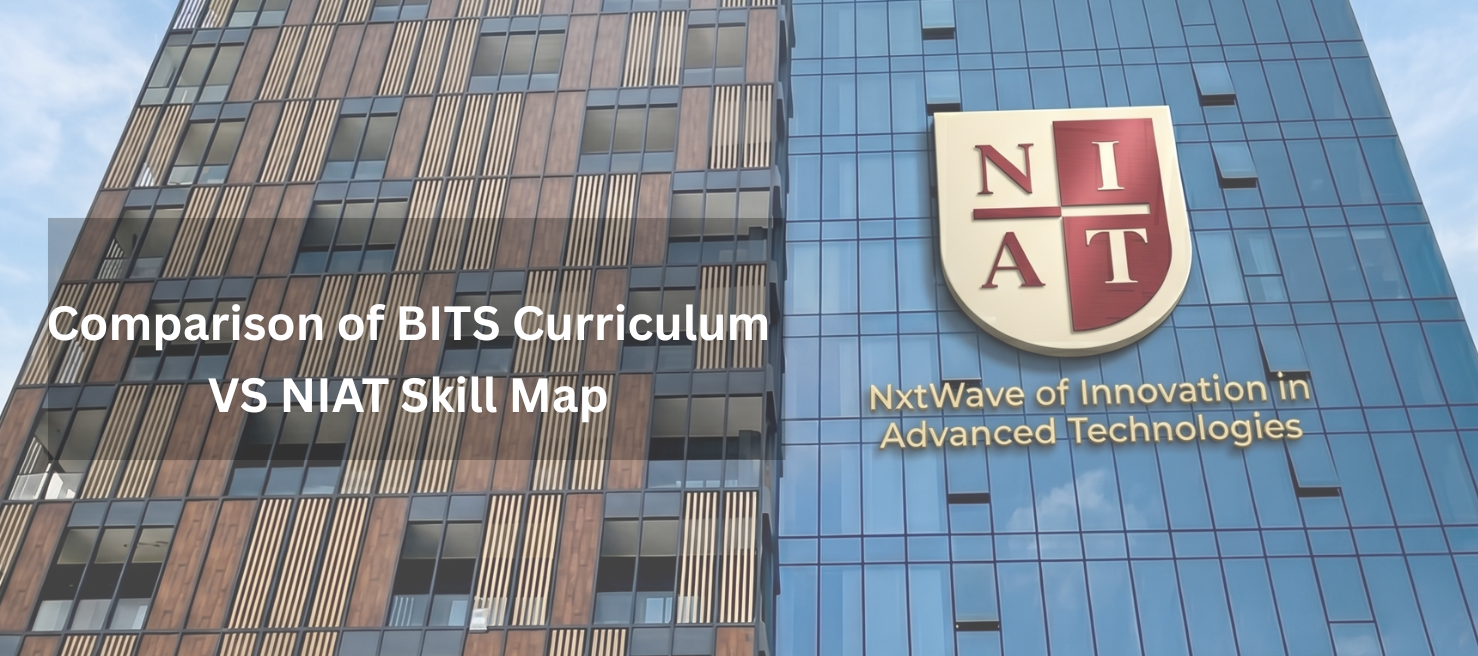
When comparing the BITS Curriculum vs NIAT Skill Map, BITS follows a modular, interdisciplinary curriculum designed to provide students with a strong academic foundation. The curriculum is focused on imparting theoretical knowledge and less on industry exposure. However, the NIAT Training module focuses on industry-relevant skills with hands-on experiences from the very first year. NIAT’s Zero-Nonsense Training Module focuses solely on practical skills through real-world projects and ensures that students acquire practical knowledge for various Global careers. Check out the full article to learn more about the BITS Curriculum vs NIAT Skill Map.
Does NIAT Skill Map Actually Get Updated Every Six Months?
NIAT continuously evolves its upskilling content by drawing on real-time insights gathered from its expansive ecosystem of 3,000+ hiring companies, 10,000+ tech professionals, and dedicated in-house research and development. These insights are carefully synthesised into structured reports that are shared with partner universities on a regular basis.
However, it is important to understand the distinction between NIAT’s upskilling content and the university’s academic curriculum. When it comes to the university’s degree program, it is entirely the university’s academic bodies, such as the Board of Studies, that review, approve, and update the curriculum through their own formal processes, in accordance with UGC and AICTE guidelines. The management and delivery of university courses, lectures, seminars, and academic sessions remain fully within the university’s jurisdiction.
Running parallel to this, NxtWave independently conducts its own skill-building sessions, hands-on workshops, practical exercises, and industry-aligned training modules as part of NIAT’s upskilling program. This ensures that students benefit from consistently fresh, market-relevant training content without any dependency on the university’s academic update cycle.
BITS Curriculum VS NIAT Skill Map: What’s the Difference?
BITS has an extensive list of core and elective courses, which makes it difficult for a student to grasp and results in flooding with too much information. However, NIAT focuses on the main courses solely required for Industry 4.0. NxtWave of Innovation in Advanced Technologies (NIAT) gives immense opportunities from various companies, including fast-growing startups and Fortune 500 giants. Here is the comparison of the BITS Curriculum vs NIAT Skill Map.
| BITS | NIAT | ||
| B.E. Computer Science | Upskilling Training Module | ||
| Core Courses | Elective Courses | Foundational Courses | Specializations Courses |
| Data Structures & Algorithms | Image Processing | Data Visualization and Analysis Using Power BI/Tableau + Excel/Spreadsheets | Data Visualization and Analysis Using PowerBI/Tableau + Excel/Spreadsheets |
| Database Systems | Neural Networks and Fuzzy Logic | Front End UI/UX development | Python Libraries |
| Object Oriented Programming | Fuzzy Logic and Applications | Computer Systems and Their Fundamentals | Probability & Applied Statistics |
| Logic in Computer Science | Human-Computer Interaction | Relational Databases: Mathematics for Computer Science | Data Science Fundamentals |
| Digital Design | Quantum Information and Computation | Design and Analysis of Algorithms Frontend Development | Product Analytics |
| Microprocessors & Interfacing | Cryptography | Data Structures | Capstone Project (Data Science) |
| Discrete Structures for Computer Science | Enterprise Computing | Backend Development DevOps | Math for Machine Learning |
| Principles of Programming Languages | Machine Learning | Advanced Algorithms | Neural Networks |
| Computer Networks | Service Oriented Computing | Product Management for Software Engineers | Computer Vision |
| Computer Architecture | Software Development for Portable Devices | Applied Computer Science (Capstone Project) | Natural Language Processing |
| Theory of Computation | Multimedia Computing | Machine Learning Ops | |
| Compiler Construction | Artificial Intelligence | Capstone Project (Machine Learning) | |
| Design & Analysis of Algorithms | Internetworking Technologies | Capstone Projects – I | |
| Operating Systems | Data Mining | Capstone Project – II | |
How does the year-wise comparison of BITS and NIAT differ?
BITS has extensive subjects with theoretical knowledge compared to NIAT, which focuses on the main subject and practices more hands-on projects. Students can check the table below for the subjects and projects they will study each year. Check out the subject-wise comparison for the BITS vs. NIAT Curriculum.
| Institutes | BITS | NIAT |
| Years | Subjects/Curriculum | |
| 1st Year | General Biology Probability and Statistics Chemistry I Chemistry II Thermodynamics Mathematics II Mathematics I Physics II Physics I Workshop Practice Engineering Graphics Computer Programming I | Computer Science Fundamentals and MERN Stack. Introduction to Generative AI, Data Science, and Automation. Hands-on Projects: Coding from day one while building real-world applications.
 |
| 2nd Year | Electrical Sciences I Structure and Properties of Materials Mathematics III Computer Programming II Electrical Sciences II Mechanics of Solids Microprocessor Programming & Interfacing Technical Report Writing Discrete Structures for Computer Science Measurement Techniques II Principles Of Management Measurement Techniques I | Data Structures & Algorithms Software Development: Learn the frameworks used by top companies worldwide.
 Tech Competitions: Prepare for Google Summer of Code (GSoC), ACM ICPC, and global hackathons. |
| 3rd Year | Data Structures and Algorithms Numerical Analysis Theory of Computation Advanced Computer Organization Operating Systems Data Base Systems Digital Electronics and Computer Organization Programming Languages & Organisation Compiler Construction Optimisation Computer Networks Control Systems Operations Research | Software Engineering Track: Deep Dive into System Design & Architecture. Learn to build large-scale applications. Data Science & AI/ML Track: Work with Big Data, Predictive Analytics & AI Models. Learn industry-level ML production. |
| 4th Year | Six Elective Courses Practice School II4 or Dissertation | Capstone Projects: Build production-ready applications.
 Become PPO-ready: Master cracking tech interviews at top MNCs and rapidly growing startups. |
What makes the NIAT Skill Map Different?
In a world where technology evolves faster than most training programs can keep up, the quality of your skill-building journey determines how quickly you land your first tech job. NIAT’s Skill-Map is not a fixed syllabus or a one-size-fits-all training plan; it is a dynamic, industry-driven learning roadmap built on continuous inputs from 3,000+ hiring companies, 10,000+ tech professionals, and dedicated in-house research.
Every training module, hands-on project, and workshop within the Skill-Map is designed to reflect what the industry needs right now, covering everything from Artificial Intelligence and Data Science to leadership, critical thinking, and entrepreneurial development. Here is a closer look at what makes the NIAT Skill-Map genuinely different.
| NIAT |
| Industry-Relevant Training Module: However, NIAT updates its skill map and includes AI, DS, and ML, ensuring that the graduates are industry-ready. |
| Hands-On Learning: NIAT emphasises practical labs, industry projects, hackathons, and case studies, which helps students become more confident in the field. |
| Flexible Learning: The NIAT Training module is updated every semester to align with the rapidly changing needs of the industry. The NIAT students don’t just build but innovate and pitch impactful business ideas to potential venture capitalists. |
| Strong Industry Collaboration: However, NIAT has a collaboration with top tech companies to provide internships, industry training, and mentorship, bridging the gap between academics and employment. |
| Modern Pedagogy: NIAT’s teaching method focuses on presentation skills, critical thinking, and leadership training that prepares the students for global careers. |
How are NIAT Success Coaches and Academic Mentors?
Another key distinction in comparing the BITS Curriculum vs NIAT Skill Map is the mentorship model. At NxtWave NIAT, Student Mentors, known as SuperMentors, come from leading companies like Amazon, Google, Meta, Microsoft, and Apple. These industry experts provide invaluable guidance to students by helping them master technical skills and develop an innovative and leadership-focused mindset. Their real-world experience ensures students understand industry expectations and strategies for building successful careers.
Academic Mentors
Academic Mentors at NIAT act as personal guides, helping students navigate complex concepts and projects. Academic Mentors are always available to offer clarity and support if a student has trouble with a technical subject, requires feedback on their code, or is looking for career advice. They provide the following support:
- 1:1 mentorship
- Doubt Resolution
- Career Guidance
- Concept Reinforcement
- Project and Code Reviews
- Communication Training
Success Coaches
NIAT success coaches are like friends who support students every step of the way. They understand your challenges and are eager to help you manage everyday stress while pursuing your dreams.
The Coaches will assist you in setting goals, tracking progress, and overcoming obstacles. Additionally, the Coaches will communicate constantly with parents to ensure that everyone is aligned and will update them regarding the student’s progress and well-being.
NIAT’s Success Coaches are dedicated to providing a supportive environment by focusing on your mental health and personal growth, where you can flourish and achieve all your goals.
Conclusion
When comparing BITS and NIAT’s approach to learning, the distinction is clear. BITS offers a strong theoretical academic foundation through its university degree programs, while NIAT (NxtWave of Innovation in Advanced Technologies) complements such academic learning with a focused, industry-aligned upskilling program. Through regularly updated skill maps, project-based training modules, hands-on learning, and guidance from experienced trainers, mentors, and success coaches, NIAT equips students with the practical, job-market-ready competencies that today’s top employers actively look for. For engineering aspirants seeking to go beyond classroom theory and build real-world technical skills alongside their university degree, NIAT’s upskilling program offers a compelling and future-ready pathway into the technology sector.
Glossary Section
| NIAT | NxtWave of Innovation in Advanced Technologies |
| NAT | NxtWave Assessment Test |
| IRC | Industry Ready Certificate |
| BITS | Birla Institute of Technology and Science |
| AI | Artificial Intelligence |
| ML | Machine Learning |
| DS | Data Science |
| CSE | Computer Science and Engineering |
| B.Tech | Bachelor of Technology |
| B.E. | Bachelor of Engineering |
| UGC | University Grants Commission |
| AICTE | All India Council for Technical Education |
| MERN | MongoDB, Express, React, Node.js |
| GSoC | Google Summer of Code |
| ACM ICPC | Association for Computing Machinery International Collegiate Programming Contest |
| MNC | Multinational Corporation |
| PPO | Pre-Placement Offer |
| R&D | Research and Development |
| CXO | Chief Experience/Executive Officer |
| UX | User Experience |
| UI | User Interface |