Summarise With AI


KCET Chapter Wise Weightage: KCET chapter wise weightage refers to the number or percentage of questions asked from different chapters in the exam. It helps aspirants identify high-priority topics by analysing trends from previous years’ question papers.
Although the KCET syllabus is based on the 1st and 2nd PUC curriculum, the number of questions asked from each chapter is not distributed equally. Analysis of previous years’ KCET papers shows that the 2nd PUC syllabus contributes more compared to 1st PUC. However, this does not mean that in the final stage of preparation you should revise every high-weightage chapter in detail. During the last phase, preparation needs to be more strategic and focused. Along with chapter-wise weightage, students should also pay attention to topics that repeatedly appear in previous KCET papers. By identifying chapters that have both high weightage and high repetition in PYQs, students can prioritise the most important topics for revision. This blog on KCET Chapter Wise Weightage 2026 is going to discuss subject-wise chapter weightage, previous year trends and More. Let’s begin!
KCET Exam Pattern: At a Glance
Before referring to the KCET Chapter Wise Weightage, candidates must be aware of the KCET Exam Pattern. Let’s have a look:
| Particulars | Details |
|---|---|
| Mode of Exam | Offline (Pen and Paper) |
| Language | English and Kannada |
| Total Subjects | Physics, Chemistry, Mathematics / Biology |
| Questions per Subject | 60 |
| Duration per Paper | 80 Minutes |
| Total Marks | 240 |
| Question Type | Multiple Choice Questions |
| Marking Scheme | +1 for correct answer, no negative marking |
KCET Chapter Wise Weightage: Subject-Wise Breakdown
The number of questions from each chapter may vary slightly every year. However, analysis of previous KCET papers shows that certain topics consistently carry higher weightage. In general, second-year PUC chapters contribute slightly more questions than first-year topics, as they involve advanced concepts and applications. The following sections provide a subject-wise breakdown of important chapters and their expected contribution in the exam.
KCET Physics Chapter Wise Weightage
The Physics paper in KCET contains 60 multiple-choice questions, and analysis of previous papers shows that the 2nd PUC syllabus contributes nearly 65–70% of the questions, while 1st PUC chapters account for around 30–35%.
1st PUC Physics Weightage
The first PUC syllabus focuses on fundamental mechanics and thermodynamics concepts. These chapters often form the base for advanced questions asked in later sections.
| Chapter | Weightage (%) |
|---|---|
| Physical World, Units & Measurements | 2–4% |
| Kinematics (Motion in Straight Line & Plane) | 6–8% |
| Laws of Motion & Friction | 5–7% |
| Work, Energy, Power & Collisions | 4–6% |
| Gravitation | 7–9% |
| Mechanics of Solids & Fluids | 5–7% |
| Thermodynamics & Kinetic Theory | 6–8% |
| Oscillations & Waves | 5–7% |
2nd PUC Physics Weightage
The second PUC syllabus includes topics such as electricity, magnetism, optics, and modern physics. These chapters usually contribute a higher number of questions in the exam.
| Chapter | Weightage (%) |
|---|---|
| Electrostatics (Charges, Fields, Potential) | 10–12% |
| Current Electricity | 8–10% |
| Magnetic Effects of Current & Magnetism | 7–9% |
| Electromagnetic Induction & AC | 7–9% |
| Ray Optics & Wave Optics | 10–12% |
| Modern Physics (Dual Nature, Atoms, Nuclei) | 8–10% |
| Semiconductors & Electronics | 5–7% |
| Electromagnetic Waves & Communication | 3–5% |
KCET Chapter Wise Weightage for Chemistry
The Chemistry section of KCET includes 60 questions covering Physical, Organic, and Inorganic Chemistry. Among these three major branches of chemistry, Organic Chemistry usually contributes the highest number of questions. For more details candidates can refer to the section below:
1st PUC Chemistry Weightage
The first-year syllabus introduces the fundamental principles of chemistry, including atomic structure, periodic trends, and chemical bonding.
| Chapter | Weightage (%) |
|---|---|
| Some Basic Concepts of Chemistry | 7–8% |
| Structure of Atom | 5–7% |
| Classification of Elements & Periodicity in Properties | 7–8% |
| Chemical Bonding & Molecular Structure | 6–8% |
| States of Matter: Gases and Liquids | 4–5% |
| Thermodynamics | 5–7% |
| Equilibrium | 5–6% |
| Redox Reactions | 4–5% |
| Hydrogen | 3–4% |
| s-Block Elements | 5–6% |
| Some p-Block Elements | 6–7% |
| Organic Chemistry – Basic Principles & Techniques | 5–7% |
| Hydrocarbons | 6–8% |
| Environmental Chemistry | 2–3% |
2nd PUC Chemistry Weightage
The second-year syllabus focuses more on reaction mechanisms, electrochemistry, coordination chemistry, and biomolecules.
| Chapter | Weightage (%) |
|---|---|
| Solid State | 6–8% |
| Solutions | 7–8% |
| Electrochemistry | 6–8% |
| Chemical Kinetics | 6–8% |
| Surface Chemistry | 4–6% |
| General Principles & Processes of Isolation of Elements | 4–5% |
| p-Block Elements | 7–9% |
| d & f Block Elements | 6–8% |
| Coordination Compounds | 5–7% |
| Haloalkanes & Haloarenes | 6–7% |
| Alcohols, Phenols & Ethers | 7–9% |
| Aldehydes, Ketones & Carboxylic Acids | 8–10% |
| Amines (Organic Compounds Containing Nitrogen) | 5–7% |
| Biomolecules | 5–7% |
| Polymers | 4–6% |
| Chemistry in Everyday Life | 3–5% |
KCET Chapter Wise Weightage For Mathematics
Mathematics is often considered the most challenging section of KCET. Out of the entire syllabus, Calculus usually contributes the highest number of questions, making it one of the most important areas for students. Chapters such as Integrals, Continuity and Differentiability, and Applications of Derivatives appear regularly in the exam.
1st PUC Mathematics Weightage
The first PUC syllabus mainly focuses on algebra and trigonometry concepts that form the foundation for advanced mathematics topics.
| Chapters | Weightage |
|---|---|
| Principle Of Mathematical Induction | 5% |
| Mathematical Reasoning | 6% |
| Introduction to 3D Geometry | 7% |
| Linear Inequalities | 7% |
| Statistics | 7% |
| Binomial Theorem | 8% |
| Sets | 8% |
| Permutation And Combination | 9% |
2nd PUC Mathematics Weightage
The second-year syllabus includes advanced calculus, matrices, and vector geometry, which frequently appear in KCET question papers.
| Chapter | Weightage |
|---|---|
| Integrals & Applications of Integrals | 9–10% |
| Continuity & Differentiability | 7–9% |
| Applications of Derivatives | 6–8% |
| Matrices & Determinants | 7–9% |
| Vectors & 3D Geometry | 6–8% |
| Probability (Advanced) | 6–7% |
| Differential Equations | 5–6% |
| Linear Programming | 3–5% |
KCET Chapter Wise Weightage For Biology
Biology is generally considered one of the most scoring subjects in KCET because many questions are straightforward and directly based on textbook concepts. Students who revise the NCERT or PUC textbooks carefully can answer a large number of questions with confidence. Topics such as Genetics, Human Physiology, Ecology, and Biotechnology frequently appear with higher weightage in the exam.
1st PUC Biology Weightage
The first PUC syllabus covers plant physiology, cell biology, and basic human physiology topics.
| Chapter | Weightage (%) |
|---|---|
| Neural Control and Coordination | 5–6% |
| Photosynthesis in Higher Plants | 5% |
| Respiration in Plants | 4–5% |
| Plant Growth and Development | 4–5% |
| Biomolecules | 4–5% |
| Plant Kingdom | 4% |
| Cell: The Unit of Life | 4% |
| Morphology of Flowering Plants | 3–4% |
| Digestion and Absorption | 3–4% |
| Breathing and Exchange of Gases | 3% |
| Excretory Products and their Elimination | 2–3% |
| Body Fluids and Circulation | 2–3% |
| Living World / Biological Classification | 2–3% |
2nd PUC Biology Weightage
The second-year syllabus includes genetics, biotechnology, ecology, and reproduction topics that frequently appear in the exam.
| Chapter | Weightage (%) |
|---|---|
| Human Reproduction / Reproduction in Organisms | 6–7% |
| Genetics and Evolution | 7–8% |
| Biotechnology: Principles & Processes + Applications | 5–6% |
| Ecology and Environment / Ecosystem / Biodiversity & Conservation | 5–6% |
| Chemical Coordination and Integration | 4–5% |
| Animal Kingdom / Structural Organisation in Animals | 4–5% |
| Microbes in Human Welfare | 3–4% |
| Molecular Basis of Inheritance | 4% |
| Strategies for Enhancement in Food Production | 3% |
KCET Chapter Wise Weightage: Most Important Chapters for Quick Revision
In the final stage of preparation, students often focus on chapters that contribute the maximum number of questions in the KCET exam. Considering the importance, our subject matter expert has collated the subject-wise important chapter.
Physics
In KCET Physics, chapters such as Gravitation, Oscillations, Thermodynamics, Magnetism, and Alternating Current frequently appear with multiple questions in the paper. Among these Gravitation is the most important chapter. You can expect atleast 8 questions from this chapter. All the important chapters from physics are presented in the table below:
| Chapter / Topic | Expected Questions |
|---|---|
| Gravitation | 8 |
| Motion in a Straight Line | 7 |
| Oscillations | 7 |
| Thermodynamics | 7 |
| Mechanical Properties of Solids | 4 |
| Mechanical Properties of Fluids | 4 |
| Kinetic Theory | 4 |
| Units and Measurement | 3 |
| Physical World | 2 |
| Magnetism and Matter | 7 |
| Alternating Current | 7 |
| Electromagnetic Induction | 6 |
| Nuclei | 6 |
| Atoms | 5 |
| Communication Systems | 3 |
| Electromagnetic Waves | 2 |
Chemistry
In the KCET Chemistry paper, several chapters contribute 6-8 questions each, particularly from both Physical and Organic Chemistry. Topics like Some Basic Concepts of Chemistry and Periodicity carry weightage of around 8 questions, while p-block elements and Alcohols, Phenols and Ethers usually contribute around 7 questions. All important chapter from KCET Chemistry has been shared below:
| Chapter | Expected Questions |
|---|---|
| Some Basic Concepts of Chemistry | 8 |
| Classification of Elements and Periodicity in Properties | 8 |
| Some p-Block Elements | 7 |
| s-Block Elements | 6 |
| Thermodynamics | 4 |
| Redox Reactions | 4 |
| Hydrogen | 3 |
| Environmental Chemistry | 2 |
| Solid State | 7 |
| Solutions | 7 |
| Alcohols, Phenols and Ethers | 7 |
| Coordination Compounds | 6 |
| Haloalkanes and Haloarenes | 6 |
| Surface Chemistry | 6 |
| Biomolecules | 6 |
| Organic Compounds Containing Nitrogen | 5 |
| Polymers | 5 |
| Chemistry in Everyday Life | 4 |
| General Principles and Processes of Isolation of Elements | 4 |
Mathematics
List of all the important chapters from Mathemetics has been shared below:
| Name of Topics | Expected Questions |
|---|---|
| Mathematical Reasoning | 06 |
| Introduction to 3-D Geometry | 07 |
| Principle of Mathematical Induction | 05 |
| Statistics | 07 |
| Linear Inequalities | 07 |
| Complex Numbers and Quadratic Equations | 09 |
| Binomial Theorem | 08 |
| Permutation and Combination | 09 |
| Sets | 08 |
| Matrices | 09 |
| Inverse Trigonometric Functions | 08 |
| Linear Programming | 07 |
| Application of Integrals | 08 |
Biology
In the Biology section, several chapters consistently contribute 4-7 questions, making them important for quick revision. From the 1st PUC syllabus, topics like Neural Control and Coordination, Photosynthesis, Respiration, and Biomolecules usually carry weightage of around 5 questions each. From the 2nd PUC syllabus, Human Reproduction contributes around 7 questions. To get more details about important chapters from Biology, candidates can refer to the section below:
| Chapter | Expected Questions |
|---|---|
| Neural Control and Co-ordination | 5 |
| Photosynthesis in Higher Plants | 5 |
| Respiration in Plants | 5 |
| Plant Growth and Development | 5 |
| Biomolecules | 5 |
| Plant Kingdom | 5 |
| Cell Cycle and Cell Division | 5 |
| Body Fluids and Circulation | 4 |
| Morphology of Flowering Plants | 4 |
| Anatomy of Flowering Plants | 4 |
| Locomotion and Movement | 4 |
| Breathing and Exchange of Gases | 3 |
| Living World | 3 |
| Excretory Products and their Elimination | 3 |
| Digestion and Absorption | 3 |
| Biological Classification | 2 |
| Human Reproduction | 7 |
| Microbes in Human Welfare | 6 |
| Biotechnology: Principles and Processes | 6 |
| Organisms and Population | 6 |
| Ecosystem | 6 |
| Environmental Issues | 6 |
| Biotechnology: Applications | 5 |
| Reproduction in Organisms | 5 |
| Reproductive Health | 5 |
| Evolution | 5 |
| Biodiversity and Conservation | 4 |
How to Use KCET Chapter Wise Weightage in KCET Preparation: Tips
From the sections above, you already got the list of important chapters. Now you have to shortlist the high-weightage chapters to make an efficient study plan. But before proceeding, keep the following points in mind :
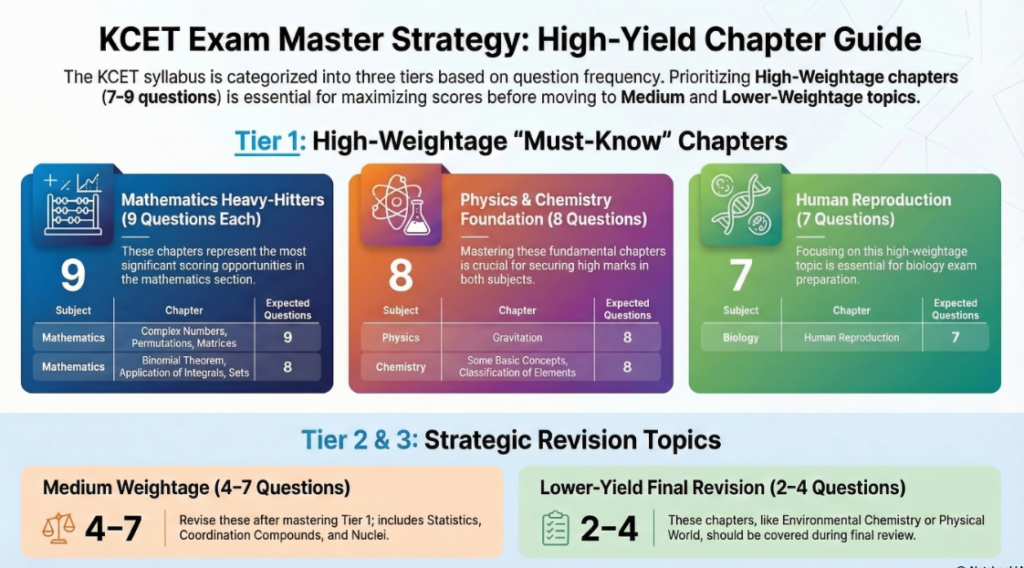
- First focus on chapters with 7-9 questions, as they contribute the largest share of the paper.
- Next revise medium-weightage chapters (4-6 questions) to strengthen overall coverage.
- Finally review lower-weightage topics during the last revision phase.
- Practice previous year KCET questions from these chapters to understand the exam pattern.
- Attempt mock tests regularly to improve time management and accuracy.
Check: KCET Question Papers
KCET Repeated Questions: Trend Analysis
Previous year question papers play a crucial role in KCET preparation because several questions are asked from similar topics or concepts every year. While the exact questions may change, the topic distribution remains consistent across Physics, Chemistry, Mathematics, and Biology.
Analysis of recent KCET papers shows that certain subject areas contribute a large portion of the total questions, making them important for students to revise regularly. By focusing on these frequently asked topics, candidates can cover a major part of the syllabus more efficiently. The table below highlights the subject-wise topic areas that repeatedly appear in KCET question papers, along with their approximate weightage.
Physics
In KCET Physics, several questions are repeatedly asked from major topic groups such as Mechanics, Electricity, and Optics. Mechanics alone can contribute 12–15 questions, making it one of the most important areas of the syllabus.
| Topic Area | How Many Times Repeated |
|---|---|
| Mechanics (Laws of Motion, Work & Energy) | 12–15 |
| Electricity & Magnetism (Current Electricity, Electrostatics) | 10–12 |
| Optics (Ray & Wave Optics) | 8–10 |
| Thermodynamics & Modern Physics | 8–10 |
| Kinematics & Other Topics | 10–12 |
Chemistry
In Chemistry, questions are commonly repeated from Organic and Physical Chemistry topics. Organic Chemistry alone contributes around 23–25 questions, making it the largest contributor to the paper.
| Topic Area | How Many Times Repeated |
|---|---|
| Physical Chemistry (Thermodynamics, Chemical Kinetics, Mole Concept) | 20–22 |
| Organic Chemistry (Hydrocarbons, Functional Groups, Reactions) | 23–25 |
| Inorganic Chemistry (Periodic Table, Bonding, Coordination Compounds) | 14–16 |
Mathematics
The Mathematics section usually includes a large number of questions from Algebra and Calculus, which together form a major portion of the paper.
| Topic Area | How Many Times Repeated |
|---|---|
| Algebra (Quadratic Equations, Matrices, Determinants) | 15–18 |
| Calculus (Differentiation, Integration) | 12–15 |
| Coordinate Geometry & Trigonometry | 10–12 |
| Probability & Statistics | 8–10 |
Biology
Biology questions often follow a consistent pattern and are mostly derived from NCERT-based concepts and diagrams. Topics related to Genetics and Physiology usually contribute the highest number of questions.
| Topic Area | How Many Times Repeated |
|---|---|
| Genetics & Evolution | 12–15 |
| Human & Plant Physiology | 10–12 |
| Ecology & Environment | 8–10 |
| Biotechnology & Other Topics | 10–12 |
Conclusion
KCET chapter-wise weightage helps students understand which chapters are more important for the exam. By looking at previous years’ trends, students can easily identify the topics that appear more frequently in Physics, Chemistry, Mathematics, and Biology. Thus, focusing on high-weightage chapters can help students perform better in the exam.