
Summarise With AI


Table of Contents
When it comes to cracking JEE Mains 2026, countless students often debate on one fundamental question on whether to take mock tests daily or weekly. The frequency of taking the JEE Mains mock test depends on the students’ preparation and the days left for the final exam. However, taking a mock test is only half the battle. The real game-changer lies in how you analyse and review those tests.
CollegeDost offers JEE Mains mock test free online platform for students to practice topic-wise and previous year questions on either a weekly or daily basis. Also, know how to analyse mistakes in 3 clear steps, which have been used by JEE Mains toppers.
Recommended for JEE Mains 2026 aspirants 👇

Understanding The Usefulness of JEE Mains Mock Test in Preparation
JEE Mains Mock tests serve as more than just practice papers; they provide students with an exam-like simulation.
- Build Exam Temperament: The psychological pressure and time constraints of a 3-hour mock test mirror the actual JEE Mains 2026 exam environment. Regular mock practice conditions your mind to handle stress, maintain focus, and make critical decisions under time pressure.
- Identify Knowledge Gaps: While chapter-wise practice helps consolidate concepts, full-length mocks reveal which topics genuinely require revision. You discover not just weak topics, but also weak combinations of topics that typically appear together in the actual exam.
- Measure Realistic Scores: Mock tests provide a percentile prediction that closely aligns with actual JEE Main rankings. By tracking your mock scores over time, you understand your current standing and can estimate your likely JEE Main rank.
- Optimise Time Management: JEE Main is as much about speed as it is about accuracy. Mock tests reveal whether you’re spending too much time on Physics, rushing through Chemistry, or getting stuck on difficult Math problems.
Weekly vs Daily JEE Mains Mock Test: A Comprehensive Comparison
The frequency of taking JEE Mains mock test simply depends on the preparation and the number of days left for JEE Mains 2026. If you are starting, it is advisable to practice a mock test for JEE Mains after you have completed the syllabus. Although you can also take topic-wise JEE Mains Mock Test to analyse your weak areas of that particular topic. For students who have started preparing for JEE Mains, taking a mock test once a week or twice a month will be enough. But as the final exam approaches, students should be more keen to take mock test more often and analyse their mistakes for improvements.
When Should You Stick to Weekly Mock Tests?
Weekly mock tests work best during the initial 4-6 months of preparation when you’re still building concepts and haven’t completed the full syllabus.
Advantages of Weekly Mock Tests:
- Deep Analysis Time: One mock per week leaves 6 days for thorough analysis, revision, and practice of weak topics.
- Concept Consolidation: Regular chapter-wise practice between mocks ensures concepts are solid before attempting full-length papers.
- Sustainable Approach: Weekly JEE Mains mock test prevents burnout and allows balanced focus on all three subjects.
- Quality Over Quantity: Limited tests force you to analyse each one meticulously, leading to actual improvement.
- School/Coaching Balance: Weekly mocks accommodate class 12 board exam preparation alongside JEE Main study.
When Should You Take Daily Mock Tests?
Daily mock tests are most beneficial during the final months before JEE Mains 2026. You can also use a mock test as your final revision, along with formula sheets and revision notes.
Advantages of Daily Mock Tests:
- Intense Pressure Simulation: Consecutive daily mocks train your brain to maintain consistent performance under relentless pressure.
- Speed Optimisation: Daily practice helps you identify and eliminate time-wasting habits rapidly.
- Confidence Building: Your body and mind adapt to the exam routine, reducing anxiety on the actual exam day.
- Mistake Frequency Tracking: Daily tests create patterns that become immediately visible, allowing quick corrections.
- Exam-Day Rhythm: Your biological clock adjusts to the 9:30 AM to 12:30 PM (or 3:00 PM to 6:00 PM) exam time.
The Hybrid Approach: Recommended Weekly Structure
Rather than sticking strictly to the weekly vs daily JEE Mains Mock Test, the most effective strategy for the JEE Mains mock test is to combine both approaches. This schedule ensures you take 2 full-length mocks weekly while dedicating 5 days to analysis and revision. During the final month, you can increase to 2-3 full mocks weekly by reducing revision time. Here’s a template followed by JEE Main toppers:
| Day | Activity | Duration | Purpose |
| Monday | Full-length mock test (90 questions) | 3 hours | Simulate exam conditions |
| Tuesday | Analyse using the 3-step method | 2-3 hours | Identify mistakes and patterns |
| Wednesday | Revise identified weak topics | 2-3 hours | Strengthen conceptual understanding |
| Thursday | Practice 15-20 questions on weak topics | 1.5 hours | Build confidence in weak areas |
| Friday | Sectional/Part test (Physics or Chemistry, or Math) | 1 hour | Quick topic-wise practice |
| Saturday | Easy-level mock or formula revision | 1.5 hours | Active recovery and consolidation |
| Sunday | Full-length mock + previous year questions (PYQ) | 3.5 hours | Track progress and practice authentic questions |
Also Check: Top 10 Reasons to Attempt JEE Main Mock Test
Topper’s 3-Step Review Method For JEE Mains Mock Test
Taking the JEE Mains mock test without analysing it is like studying without solving problems – utterly ineffective. The 3-step review method, preferred by JEE Main 99%ile scorers, transforms each mock into a learning experience that directly improves your score in the next test.
Step 1: The Three-Bucket Classification Method
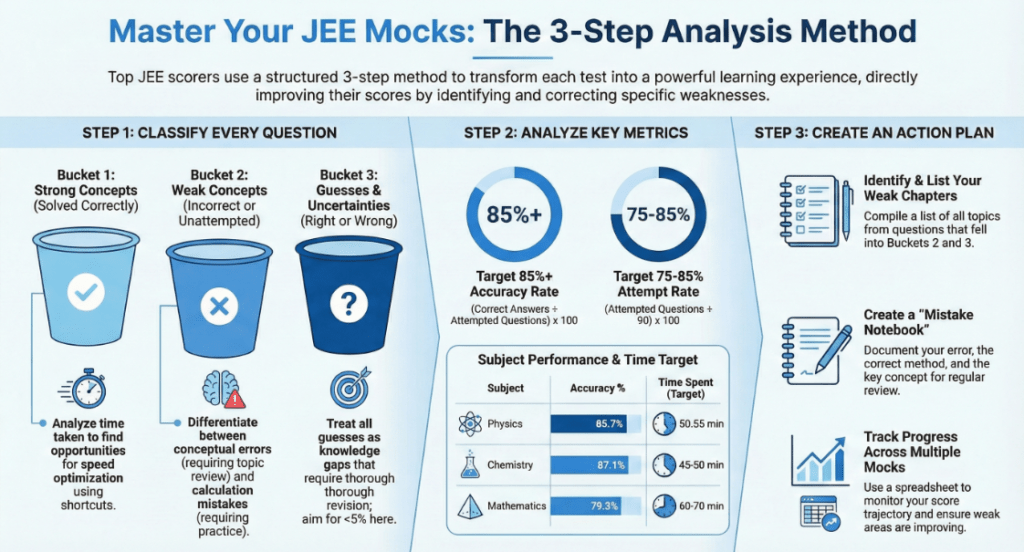
Immediately after finishing your mock test, classify all 90 questions into three buckets based on your confidence level and approach:
Bucket 1: Strong Concept Questions (Solved Correctly with Confidence)
For every question you solved correctly and knew the concept well, ask yourself:
- How much time did it take to solve? (Record in seconds)
- Did I use the direct method or a shortcut/trick? If you used a shortcut, note it down
- Was double-checking necessary, or did direct calculation work?
For example, if you solved an Optics question on the lens formula in 90 seconds using direct calculation, but later discovered a trick that solves it in 45 seconds, you’ve found your time-optimisation opportunity.
Action: Maintain an “Optimisation Notebook” where you record faster methods for problems you solve correctly. Before your next mock, review these tricks to improve speed.
Bucket 2: Weak Concept or Incorrect Answer Questions
For every question you got wrong or left blank, dig deeper:
- Was it a conceptual error? (You didn’t understand the underlying principle)
- Or a silly/calculation mistake? (You understood the concept but made arithmetic errors or misread the question)
- Were you confused between similar-looking options? (Common in multi-select questions)
For example, if you marked the wrong answer in a Thermodynamics question, determine whether you didn’t understand the First Law of Thermodynamics (conceptual) or you calculated the final answer incorrectly despite understanding the concept (calculation).
Action: Create two separate lists – one for conceptual gaps and another for calculation errors. Conceptual gaps require a full topic review; calculation errors require practice with accuracy drills.
Bucket 3: Guessing or Uncertain Questions (Right or Wrong)
This bucket separates toppers from average students:
- If you guessed and got it right: Don’t celebrate. This is dangerous because it masks a knowledge gap. You must revise the concept thoroughly
- If you guessed and got it wrong: Analyze why you attempted without clarity. Was the question too ambiguous? Did you run out of time? Did you misunderstand the topic?
For example, if you guessed “Option C” in an Electrochemistry question and coincidentally got it right, you must still study that topic properly because the next time, you might guess wrong and lose 4 marks (1 mark for the correct answer minus 1/4 mark for the wrong answer = negative 0.25 marks).
JEE Toppers set a goal to minimise this bucket to less than 5% of total questions. Each question in Bucket 3 requires conceptual review and targeted practice.
Step 2: Quantitative Performance Analysis
After bucketing, calculate these key metrics:
Accuracy Rate = (Correct Answers ÷ Attempted Questions) × 100
Target: 85%+ accuracy. If your accuracy is below 85%, you’re either rushing or attempting questions without sufficient confidence.
Attempt Rate = (Attempted Questions ÷ Total 90 Questions) × 100
Target: 75-85% attempt rate. Below 75% means you’re being overly cautious; above 85% suggests you’re guessing too much.
Subject-Wise Breakdown:
| Subject | Questions Attempted | Correct | Incorrect | Accuracy % | Time Spent |
| Physics | 28 | 24 | 4 | 85.7% | 52 min |
| Chemistry | 31 | 27 | 4 | 87.1% | 48 min |
| Mathematics | 29 | 23 | 6 | 79.3% | 60 min |
| Total | 88 | 74 | 14 | 84.1% | 160 min |
This table immediately reveals that your Math accuracy is lower than in other subjects, suggesting it needs focus in your revision schedule.
Time Management per Subject:
JEE toppers allocate:
- Physics: 50-55 minutes
- Chemistry: 45-50 minutes
- Mathematics: 60-70 minutes
If you spent 75 minutes on Physics, you were either solving very difficult questions or wasting time on ones you couldn’t solve. Document this observation for the next mock.
Step 3: Topic-Wise Deep Dive and Revision Planning
This final step converts analysis into action:
Identify Your Weak Chapters:
From your Bucket 2 and 3 analysis, list all chapters where you made mistakes. For instance:
- Physics: Rotational Motion, Electromagnetic Induction
- Chemistry: Organic Chemistry Mechanisms, Coordination Compounds
- Mathematics: Probability, Integration
Plan Topic-Wise Revision:
For each weak topic, follow this sequence:
- Watch the concept video (15-20 minutes from your coaching materials or YouTube)
- Read NCERT + your notes (15-20 minutes)
- Solve 10-15 fresh questions from that topic (30-40 minutes)
- Reattempt the same mock questions after 2-3 days to verify improvement
Create a Mistake Notebook:
Maintain a physical or digital notebook where you write:
- Question number and topic
- Your wrong approach and why it was wrong
- The correct approach with explanation
- Any formula or concept key to avoiding the mistake
Review this notebook 2-3 times per week. Toppers swear this notebook becomes their most valuable study asset.
Track Progress Over Multiple Mocks
Maintain a master spreadsheet tracking 10-15 consecutive mocks. This spreadsheet shows your trajectory. If weak areas aren’t improving over 3-4 mocks, change your revision strategy for those topics.
| Mock No. | Total Score | Accuracy % | Physics | Chemistry | Maths | Weak Areas |
| Mock 1 | 180 | 82% | 70 | 75 | 35 | Maths, Induction |
| Mock 2 | 195 | 85% | 75 | 75 | 45 | Probability |
| Mock 3 | 210 | 87% | 80 | 80 | 50 | Weak |
Boost Your Confidence with This Short Mock Test 👇

Common Mistakes To Avoid in JEE Mains Mock Test Analysis
Preparing for the JEE paper isn’t just about finishing chapters or taking one JEE Mains mock test after another. Real progress comes from understanding what each test reveals. When you correct your mistakes and regularly review JEE Mains PYQ, patterns begin to surface. Keep these common errors in mind while analysing your mocks so every attempt actually moves you closer to your goal.
- Not Analysing At All: Many students take 20 to 30 JEE Mains mock tests but barely look back at them. Scores stop improving because the same errors keep repeating. Analysis is where rank growth hides.
- Over-Analysing Irrelevant Details: One random, silly mistake does not define your preparation. Instead, look for patterns, the repeated chapters in which you are making mistakes. Take note of the topics or concepts that collapse under pressure. That is what shapes performance in the real JEE paper.
- Attempting Too Many Mocks Without Depth: More mocks do not guarantee better marks. Five well-analysed mocks beat twenty rushed ones. Review accuracy, time taken, guesswork, and solutions you misunderstood.
- Ignoring Time Management Data: If Physics always spills beyond the clock or Chemistry finishes too fast with too many errors, adjust the strategy. Track this for every mock across the JEE Mains 2026 syllabus.
- Not Reattempting Weak Topics: After you identify mistakes, strengthen them. Solve 10 to 20 fresh questions from the same topic. Then revisit the same mock questions after two or three days. Retention snaps into place.
- Skipping Previous Year Questions: JEE Mains PYQ reveal trends of the question paper. The way questions evolve often hints at what may repeat. Reserve one weekly mock slot only for PYQ and treat it as seriously as a real exam.
Also Check: JEE Mains Mock Test 2026 Instructions
How to Prepare for JEE Mains 2026?
JEE Main preparation can feel like climbing a glittering skyscraper of formulas and concepts, but with clear planning and steady habits, the view from the top becomes attainable. Treat your study hours like carefully placed stepping stones, and you’ll turn uncertainty into quiet confidence. Check some of the JEE Main preparation tips given below.
- Build a realistic study plan that covers every subject and leaves daily time for revision. Think of it as your master map for JEE Main exam preparation.
- Start with concepts, not shortcuts. Strong fundamentals make problem-solving faster during JEE Main preparation.
- Practice topic-wise questions weekly and full-length mock tests twice a month. Review mistakes like a detective, not a judge.
- Keep a “revision notebook” for formulas, exceptions, and tricky ideas. This becomes gold during the last-minute JEE Main exam preparation.
- Use NCERT thoroughly for Chemistry, then layer in standard reference books for depth.
- Train your timing. Solve questions with a clock nearby so your JEE Main preparation aligns with real exam pressure.
- Analyse mock test results. Focus on accuracy first, speed second.
- Limit distractions. Curate your digital space like a quiet library. Also, stay consistent. Even one focused hour daily beats a weekend storm of rushed study.
Study Materials and Additional Resources for JEE Mains Preparation
In addition to practising regular JEE Mains mock test, leveraging the right study materials and supplementary resources can dramatically improve your JEE Mains preparation. Here are key resources every aspirant should use alongside mock tests:
- Previous Year Question Papers (PYQs): Practising JEE Mains PYQs helps you understand recurring question patterns, difficulty levels, and important topics. Dedicate one mock slot per week to solving PYQs and analyse your performance just as you would with a regular mock.
- Revision Notes: Maintain concise, organised notes for each subject. Use these for quick revision before mocks and during the final weeks. Summarise formulas, key concepts, and exceptions.
- Topic-wise and Chapter-wise Practice Questions: Focused practice on weak chapters, as identified through your mock test analysis, is essential. Use chapter-wise question banks to address specific conceptual gaps.
- Formula Sheets: Create formula sheets for Physics, Chemistry, and Mathematics. Regularly review and update these as you progress through your preparation.
- Study Plan Templates: Follow a structured daily and weekly study timetable. Adjust your plan based on mock test analysis, allocating extra time for challenging topics.
- Preparation Tips and Strategy Guides: Read expert tips on time management, exam temperament, and common pitfalls. Integrate these into your study routine.
- Reference Books: Build your conceptual foundation with NCERT textbooks, then use standard reference books for advanced problem-solving and deeper understanding.
Conclusion
In the end, the real difference between success and stagnation isn’t how often you take a JEE Mains Mock Test, but how wisely you review it. Whether you follow Weekly vs Daily JEE Mains Mock Test planning or a balanced hybrid schedule, what matters is consistent reflection, targeted revision, and disciplined tracking of mistakes. Treat every mock as a rehearsal for the real stage, use structured mock test analysis to sharpen accuracy, and let each attempt refine your overall JEE Mains preparation. When strategy meets effort, scores begin to climb quietly, and confidence becomes your greatest advantage.
Frequently Asked Questions
1. Do JEE Main Mock Test really predict the actual JEE Main rank?
They don’t predict perfectly, but a consistent trend across multiple JEE Mains Mock Tests gives a realistic percentile range. Focus more on accuracy growth and fewer negative marks than on single-test rank.
2. How many JEE Mains Mock Tests should I take in a week?
For most students, 1 weekly JEE Mains Mock Test is ideal during concept-building. As the exam nears, increase to 2–3 mocks weekly, but analyse each paper deeply instead of rushing through multiple tests.
3. Which is better: Weekly vs Daily JEE Mains Mock Test practice?
Daily mocks help only when revision is complete, and accuracy is stable. Weekly mocks suit students still revising concepts. The smart path is a hybrid plan: structured weekly mocks + targeted sectional tests.
4. Should I review every JEE Mains mock test immediately or take them back-to-back?
Review within 24 hours of taking the mock while patterns are fresh, but avoid analysing while fatigued. Take back-to-back mocks only in the final month.
5. Should I solve PYQ along with the JEE Main mock test?
Absolutely. JEE Mains PYQ reveal exam patterns, difficulty style, and recurring concepts. Although CollegeDost JEE Main mock test online free platform has all the PYQs along with the topic-wise questions. Combine JEE Main PYQ practice with weekly JEE Mains Mock Test analysis to strengthen exam temperament.