Summarise With AI


Table of Contents
Most JEE Main aspirants believe that finishing the syllabus and revising formulas is enough. But every year, thousands of students realise very late that knowing concepts and performing well in the exam are two different things. This gap is where JEE Main 2026 mock test plays an important role.
A mock test is not just a practice paper. It is a tool that prepares your mind for pressure, time limits, and decision-making. However, mock tests work only when they are used correctly. Randomly attempting tests without a plan often leads to frustration instead of improvement. This article explains how to follow proper JEE Main 2026 mock test instructions, using logic, topper habits, and smart analysis.
Recommended for JEE Mains 2026 aspirants 👇

What Mock Tests Actually Test Beyond the JEE Mains 2026 Syllabus
Many students think mock tests only check JEE Mains Syllabus 2026 completion. In reality, they test much more. A mock test for JEE Mains evaluates:
- How quickly you recall formulas under stress
- Whether you can select the right questions
- How well you manage time across three subjects
- How accurately you solve easy questions
- How calmly you handle unfamiliar problems
This is why two students with the same preparation level can score very differently. Mock tests expose gaps that books and revision cannot.
Before You Start a JEE Main 2026 Mock Test: What Toppers Actually Do
One of the biggest mistakes students make is starting a mock test without mental preparation. Toppers follow a fixed routine before attempting any JEE Main online mock test. They usually revise for 4 to 6 hours before the test, focusing on:
- Formula-heavy Physics chapters
- NCERT-based Inorganic Chemistry
- Memory-oriented topics like Biomolecules, Environmental Chemistry, and Polymers
These topics often contain direct questions. Forgetting a simple formula can cost easy marks. Repeated revision ensures quick recall during the test. The goal before a mock is not learning new topics, but refreshing what you already know.all during the test. The goal before a mock is not learning new topics, but refreshing what you already know.
How to Attempt JEE Mains Mock Test 2026: A Phase-Based Strategy
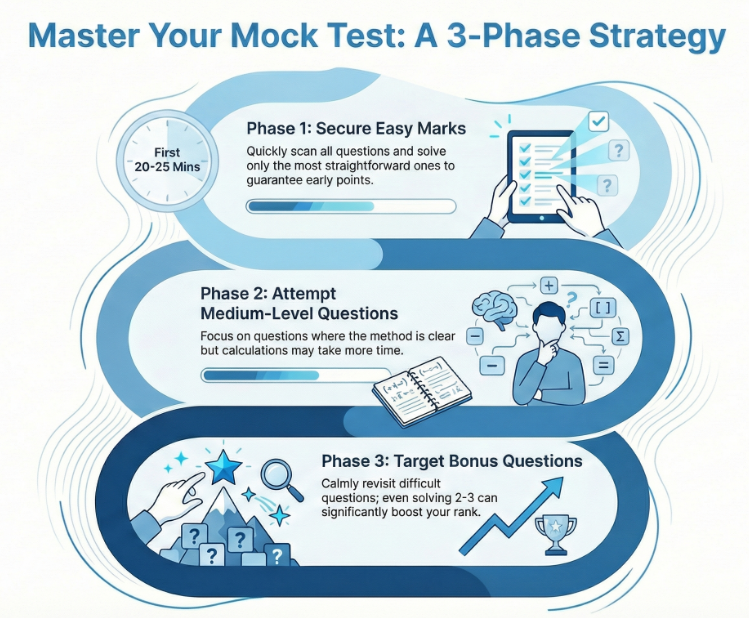
Most students attempt mock tests in one continuous flow and get stuck on difficult questions. Toppers break the paper into phases and attempt it strategically.
Phase 1: Secure Easy and Sure Questions First
In the first 20–25 minutes:
- Quickly scan all questions
- Solve questions that feel immediately doable
- Skip anything that needs deep thinking
These questions are usually straightforward and carry guaranteed marks. Solving them early builds confidence and removes panic about missing easy questions later.
Phase 2: Attempt Medium-Level Questions with Control
In the next phase:
- Solve questions where the approach is clear, but calculation is longer
- Use “Mark for Review” wisely
- Avoid forcing tough questions
This phase decides the bulk of your score. Smart time control here prevents unnecessary mistakes.
Phase 3: Bonus Question Approach for Extra Marks
In the final phase:
- Revisit difficult or unfamiliar questions
- Attempt them calmly, without pressure
- Treat them as bonus opportunities
Even solving 2-3 extra questions in this phase can increase your score by 12–20 marks, which can significantly improve your percentile.
JEE Main 2026 Mock Test Pattern
Mock tests should strictly follow the real exam structure to be effective. A detailed insight into the exam pattern has been shared below:
| Particulars | Details |
| Exam Mode | CBT |
| Subjects | Physics, Chemistry, Mathematics |
| Questions | 75 total |
| Sections | MCQs + Numerical value questions |
| Duration | 3 hours (4 hours for PwD) |
| Marking | +4 correct, -1 incorrect (MCQs) |
| Total Marks | 300 |
JEE Main Mock Paper Pattern B.E./B.Tech (Paper 1)
Here’s the JEE Main Mock test pattern for B.E./B.Tech (Paper 1):
| Section | Subject | No. of Questions | Type of Questions | Marks per Question | Total Marks |
| Section A | Physics | 20 | Multiple Choice Questions (MCQs) | +4 for correct | 80 |
| Section B | Physics | 5 | Numerical Value Type | +4 for correct | 20 |
| Section A | Chemistry | 20 | Multiple Choice Questions (MCQs) | +4 for correct | 80 |
| Section B | Chemistry | 5 | Numerical Value Type | +4 for correct | 20 |
| Section A | Mathematics | 20 | Multiple Choice Questions (MCQs) | +4 for correct | 80 |
| Section B | Mathematics | 5 | Numerical Value Type | +4 for correct | 20 |
| Total | 75 to attempt | MCQs + Numerical Questions | 300 | ||
| Negative Marking | -1 for incorrect MCQs, no negative marking in numerical questions. | ||||
| Choice | In Section B, out of 10 numerical questions, only 5 need to be attempted in each subject. | ||||
JEE Main Mock Paper Pattern B. Arch/ B. Planning (Paper 2A/2B)
Here’s the JEE Main Mock test pattern for B.Arch (Paper 2A) and B.Planning (Paper 2B):
| Particulars | B.Arch (Paper 2A) | B.Planning (Paper 2B) |
| Subjects | Mathematics, Aptitude Test, Drawing Test | Mathematics, Aptitude Test, Planning-based Questions |
| Mode of Exam | Mathematics & Aptitude – Computer Based Drawing – Pen & Paper | Entirely Computer Based |
| Total Marks | 400 | 400 |
| Question Type | MCQs and Numerical Value Questions | MCQs and Numerical Value Questions |
| Marking Scheme | +4 for each correct answer –1 for each incorrect answer | +4 for each correct answer –1 for each incorrect answer |
| Medium of Exam | English, Hindi, and regional languages as per NTA list | English, Hindi, and regional languages as per NTA list |
Using Weightage of Chapters in JEE Mains Smartly During JEE Main 2026 Mock Practice
Not all chapters carry equal importance. Knowing weightage helps you prioritise mock test practice.
Mathematics
The Mathematics section in JEE Main is heavily dominated by Class XII topics, especially Geometry and Calculus. Chapters like Three Dimensional Geometry, Calculus and Algebra-based topics such as Sequences & Series and Binomial Theorem together contribute a significant portion of the paper.
| Chapter Name | Weightage |
| Three Dimensional Geometry | 7.35% |
| Sequences and Series | 5.74% |
| Limit, Continuity and Differentiability | 5.50% |
| Definite Integration | 5.08% |
| Binomial Theorem | 5.05% |
| Complex Number | 4.75% |
| Applications of Derivatives | 4.75% |
| Vector Algebra | 4.69% |
| Differential Equations | 4.16% |
| Determinants | 4.00% |
| Permutations and Combinations | 3.60% |
| Matrices | 3.46% |
| Quadratic Equations | 3.30% |
| Circles | 3.24% |
| Probability | 3.09% |
| Statistics | 3.00% |
| Application of Integrals | 2.97% |
| Straight Lines | 2.71% |
| Parabola | 2.44% |
| Ellipse | 2.11% |
| Hyperbola | 1.65% |
| Indefinite Integration | 1.65% |
| Inverse Trigonometric Functions | 1.59% |
| Trigonometric Equations | 1.35% |
| Relations and Functions | 1.25% |
| Methods of Differentiation | 1.24% |
| Trigonometric Ratios and Identities | 1.02% |
| Sets | 1.00% |
| Basic Mathematics and Logarithm | 0.59% |
| Properties of Triangle | 0.36% |
Physics
Electricity & Magnetism, Modern Physics, and Optics have the highest weightage in Physics. To get more information on chapter-wise weightage, candidates should refer to the table below:
| Chapter Name | Weightage |
| Current Electricity | 6.57% |
| Ray Optics and Optical Instruments | 5.04% |
| Semiconductor Electronics | 4.75% |
| Gravitation | 4.49% |
| Electrostatic Potential and Capacitance | 4.49% |
| Rotational Motion | 4.31% |
| Units and Measurements | 4.24% |
| Dual Nature of Radiation and Matter | 4.05% |
| Alternating Current | 3.73% |
| Oscillations | 3.25% |
| Electromagnetic Induction | 3.25% |
| Electric Charges and Fields | 3.18% |
| Nuclei | 3.14% |
| Thermodynamics | 3.06% |
| Mechanical Properties of Fluids | 3.00% |
| Electromagnetic Waves | 2.96% |
| Motion in a Plane | 2.92% |
| Moving Charges and Magnetism | 2.89% |
| Kinetic Theory of Gases | 2.88% |
| Motion in a Straight Line | 2.63% |
| Centre of Mass and System of Particles | 2.56% |
| Atoms | 2.48% |
| Work, Energy and Power | 2.37% |
| Wave Optics | 2.30% |
| Mechanical Properties of Solids | 2.08% |
| Thermal Properties of Matter | 2.08% |
| Newton’s Laws of Motion | 2.05% |
| Waves | 1.94% |
| Magnetism and Matter | 1.90% |
| Mathematical Tools | 0.00% |
Chemistry
Chemistry focuses on chapters like Aldehydes & Ketones, Coordination Compounds, d–f Block Elements, Amines, and Biomolecules, carrying the highest weightage.
| Chapter Name | Weightage |
| Aldehydes, Ketones and Carboxylic Acids | 5.95% |
| Coordination Compounds | 5.33% |
| d and f Block Elements | 4.69% |
| Solutions | 4.54% |
| Equilibrium | 4.44% |
| Amines | 4.40% |
| s-Block Elements | 4.16% |
| Biomolecules | 3.99% |
| p-Block Elements (Group 15–18) | 3.68% |
| Chemical Thermodynamics | 3.65% |
| Chemical Kinetics | 3.61% |
| Alcohols, Phenols and Ethers | 3.54% |
| Atomic Structure | 3.34% |
| Chemical Bonding | 3.34% |
| Electrochemistry | 3.30% |
| Hydrocarbons | 3.03% |
| Environmental Chemistry | 2.99% |
| Surface Chemistry | 2.99% |
| Some Basic Concepts of Chemistry | 2.82% |
| Hydrogen | 2.82% |
| Haloalkanes and Haloarenes | 2.65% |
| Chemistry in Everyday Life | 2.20% |
| Polymers | 2.06% |
| Purification and Analysis of Organic Compounds | 1.94% |
| Periodicity | 1.93% |
| States of Matter | 1.89% |
| Redox Reactions | 1.75% |
| Solid State | 1.72% |
| General Organic Chemistry | 1.20% |
| Salt Analysis | 0.50% |
| Isomerism | 0.27% |
| IUPAC Nomenclature | 0.10% |
How to Prepare for JEE Mains?
With the JEE Main exam beginning on 21 January, students now need a focused and realistic mock test plan rather than random practice. At this stage, mock tests should help you revise important topics, improve speed, and build confidence for the actual exam day. Below is a structured plan explaining when to take mock tests, how often to attempt them, and what each stage should achieve.
Stage-wise JEE Main Mock Test Plan
| Stage of Preparation | Time Period | Type of Mock Tests | Frequency | Purpose |
| Syllabus Consolidation Stage | 3–2 weeks beforethe exam | Now till 3 weeks before the exam | 2–3 tests per week | Revise important chapters, strengthen weak areas, and improve subject-wise accuracy |
| Transition Stage | Last 7 days before the exam | Mixed sectional + partial full-syllabus mocks | 3 mocks per week | Shift from topic-based practice to exam-level thinking |
| Full-Length Practice Stage | Last 2–3 days before the exam | Full syllabus mock tests (timed) | 3–4 full mocks per week | Build stamina, improve time management, and finalise exam strategy |
| Exam Simulation Stage | Full-length mocks at the actual exam time slot | Last 14–10 days before the exam | 1 mock per day or alternate days | Train your mind for the exact exam environment |
| Light Revision Stage | Last 2–3 days before exam | Selected previous mocks + PYQs | No new mocks | Reduce stress, revise mistakes, and retain confidence |
Boost Your Confidence with This Short Mock Test 👇

How to Use JEE Mains Mock Test Free Online Effectively During This Period
- Do not attempt a mock just for marks. Every mock should be followed by proper analysis.
- Spend 1–2 hours analysing each mock test, focusing on:
- Conceptual mistakes
- Calculation or silly errors
- Time-consuming questions
- Maintain a small mistake notebook and revise it regularly.
- In the last week, avoid overloading yourself with too many mocks. Quality matters more than quantity.
Final Week JEE Mains Mock Test 2026 Strategy
In the final week, you must attempt mock tests at the same time slot as your actual exam (morning or afternoon). Now you need to focus on:
- Accuracy over attempts
- Question selection strategy
- Staying calm during tough sections
Note: Stop taking new mocks 1-2 days before the exam and revise formulas, short notes, and past mistakes.
How to Analyse JEE Mains Mock Test 2026 Scores Without Panicking
Many students feel stressed after checking mock test scores, especially when marks fluctuate. However, most real improvement in JEE Main happens after the mock test, not during the test itself. The purpose of analysis is not to judge yourself, but to understand mistakes and fix them before the actual exam. After completing a JEE Main mock test, follow the routine below:
- Take a short break to reset your mind
- Analyse the test on the same day while the paper is still fresh
- Identify why a mistake happened, not just where it happened
- Avoid focusing only on total marks; look for patterns in errors
This approach reduces panic and turns every mock test into a learning opportunity.
A Simple 3-Category Method to Analyse JEE Mains Mock Test 2026
To keep analysis clear and practical, divide questions into three categories:
- Questions you knew but took too much time: These are conceptually clear but method-heavy. Look for faster approaches, shortcuts, or better calculation flow.
- Questions you got wrong due to concept or calculation errors: These point to weak topics or carelessness. Revise the exact chapter and practise similar questions.
- Questions you guessed without clarity: These are risky. Even if a guess works once, aim to reduce such attempts over time. Toppers actively minimise this category.
Why a Mistake Notebook Improves JEE Mains Mock Test 2026 Performance
Many toppers maintain a simple mistake notebook, which plays a big role in improving scores. Writing mistakes down helps ensure they don’t repeat across multiple mocks. A useful mistake notebook includes:
- The topic where the mistake occurred
- The type of error (conceptual, calculation, or silly)
- The correct formula, concept, or approach
How Often Should You Take JEE Mains Mock Test 2026?
There is no fixed number that guarantees success. What matters more is quality analysis, not quantity. A balanced frequency works best:
- Early phase: 1 mock test per week
- Mid phase: 2 mock tests per week
- Final month: 2-3 mock tests per week with full analysis
JEE Mains Mock Test 2026 and Previous Year Questions: How to Use Both Together
Mock tests and JEE Mains PYQ serve different purposes, and using both together gives better results. Collegedost has all the JEE Mains PYQs uploaded in the mock test portal, so students can benefit from both at one place:
- Mock tests build speed, stamina, and time management
- Previous year questions reveal exam trends and recurring concepts
- Together, they improve confidence and reduce exam-day surprises
JEE Main Mock Test: Common Mock Test Mistakes
Some common habits prevent score improvement even with regular practice:
- Attempting every question blindly
- Skipping mock test analysis
- Obsessing over marks instead of learning from errors
- Guessing excessively
- Not revising weak topics after mocks
Conclusion
Mock tests are one of the most powerful tools for JEE Main 2026 preparation, but only when used with the right strategy. A planned approach to attempting, analysing, and revising mock tests helps improve speed, accuracy, and confidence. When mock tests are treated as learning tools rather than scorecards, they become the bridge between preparation and performance
Frequently Asked Questions
1. Are JEE Mains mock tests available online for free for 2026 preparation?
Yes, many platforms offer free online JEE Mains mock tests for both 2025 and 2026 aspirants. These tests are useful for early and mid-stage preparation. Students should check that the mock tests follow the latest syllabus, exam pattern, and marking scheme before using them for serious practice.
2. Is there any difference between JEE Mains Mock Test 2025 and JEE Mains Mock Test 2026?
Yes. While the core syllabus remains the same, mock tests for different years may reflect changes in exam trends, difficulty level, and question distribution. Aspirants preparing for JEE Mains 2026 should prefer 2026-focused mock tests to get a more realistic exam experience.
3. Can I download JEE Mains mock test PDF with solutions for offline practice?
No. Collegedost’s online mock test portal does not provide downloadable PDF mock tests for offline practice. The tests are designed to be taken online so that students receive detailed subject-wise analysis, performance insights, accuracy reports, and time-management feedback immediately after the test.
4. Are NTA-based JEE Mains mock tests more reliable for exam preparation?
Mock tests designed according to NTA guidelines are generally more reliable because they closely match the actual exam pattern, question format, and time structure. Practising with NTA-aligned mock tests helps students become comfortable with the real exam environment.
5. Should I practise chapter-wise JEE Mains mock tests or full-length tests first?
Chapter-wise JEE Mains mock tests are more useful during the learning and revision phase, as they help strengthen individual topics. Full-length mock tests should be attempted after completing a major portion of the syllabus to improve speed, accuracy, and overall exam readiness.