Summarise With AI


The KCET Exam 2026 was conducted successfully on April 23 in two shifts for Physics and Chemistry. Students across Karnataka appeared for the exam and shared mixed reactions regarding the difficulty level, question pattern, and time management. If you are looking for the latest KCET exam analysis 2026, this detailed review covers subject-wise paper difficulty, important topics asked, expected performance, and student feedback.
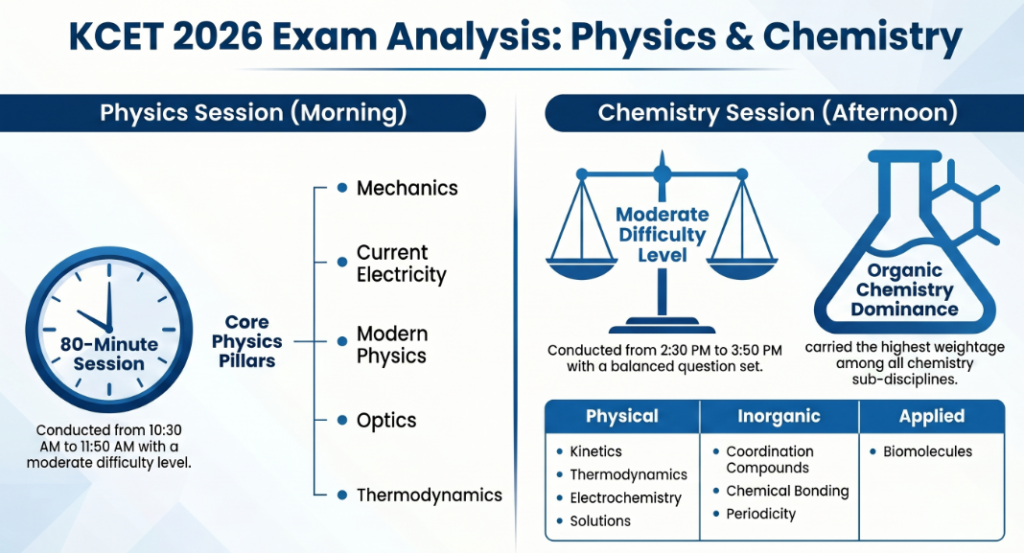
The KCET exam timings for Physics and Chemistry are conducted in two separate shifts on the same day. Physics is held in the morning shift from 10:30 AM–11:50 AM and Chemistry in the afternoon shift, i.e. from 2:30 PM–3:50 PM.
Where can I check KCET exam analysis 2026?
You can check the latest KCET exam analysis 2026 on the CollegeDost platform after each shift. It includes subject-wise difficulty level, student reactions, expected good attempts, and important topics asked.
After the KCET Exam Analysis 2026, candidates can check their expected rank from CollegeDost’s KCET Rank Predictor.
KCET 2026 Exam Overview
The KCET 2026 Exam Overview helps students understand the paper structure, timings, marking scheme, and exam mode. The exam is conducted by the Karnataka Examinations Authority for admission into engineering, pharmacy, agriculture, and other professional courses.
| Parameters | Details |
|---|---|
| Exam Name | Karnataka Common Entrance Test |
| Conducting Body | Karnataka Examinations Authority (KEA) |
| Exam Mode | Offline (Pen and Paper) |
| Exam Dates | 23rd April 2026 |
| Time & Subjects | Physics: 10:30 AM–11:50 AM Chemistry: 2:30 PM–3:50 PM |
| Questions per Subject | 60 |
| Marks per Subject | 60 |
| Negative Marking | None |
| Duration per Paper | 80 minutes |
| Question Type | MCQs |
| Official Website | https://cetonline.karnataka.gov.in/kea |
KCET Exam Analysis 2026 April 23rd
The KCET 2026 paper analysis for April 23 suggests that both Physics and Chemistry papers were moderate overall. While Physics focused more on concepts and theory, Chemistry had a balanced mix of NCERT-based theory and numerical questions. Students who prepared from the syllabus fundamentals found the papers manageable.
KCET 2026 Exam Analysis Physics
The KCET 2026 Exam Analysis Physics for the April 23 morning session indicates that the paper was moderate in difficulty and largely concept-based. The Physics section featured a balanced mix of direct formula-based and application-oriented questions.
According to students, the paper covered important topics such as Mechanics, Current Electricity, Modern Physics, Optics, and Thermodynamics. Many candidates found the paper manageable with proper preparation, although a few numerical and conceptual questions required deeper understanding and careful time management. Overall, the Physics paper was considered balanced and student-friendly for those with strong fundamentals.
| Parameter | Details |
|---|---|
| Exam Time | 10:30 AM – 11:50 AM |
| Subject | Physics |
| Topics Covered | Mechanics, Current Electricity, Modern Physics, Optics, Thermodynamics |
| Difficulty Level | Moderate |
Important Topics of Physics in KCET 2026
The Physics paper included questions from high-weightage Class 11 and 12 chapters. Students reported that Modern Physics, Mechanics, and Current Electricity carried a strong presence. Formula-based chapters like Thermodynamics and Waves were scoring.
| Topics | Difficulty Level | Expected Questions | Key Highlights |
|---|---|---|---|
| Modern Physics (Atoms, Nuclei, Semiconductors) | Moderate-Tricky | 6-8 questions | 3-4 tricky questions, conceptual, slightly unpredictable |
| Mechanics (Laws of Motion, WEP, Gravitation) | Easy-Moderate | 8-10 questions | Class 11 dominant, slightly reduced weightage vs 2025 |
| Thermodynamics & Oscillations/Waves | Easy | 5-7 questions | Direct formula-based, high-scoring |
| EMI & Alternating Current | Moderate | 4-6 questions | Formula-heavy, standard questions |
What are the Students’ Reactions of KCET Physics Exam 2026?
According to students, the KCET 2026 Physics paper received mixed reactions, with many feeling they scored below their expectations. Students felt demoralised after the exam, and some said the paper was confusing and poorly balanced. Many were surprised by the high number of theory-based questions instead of numericals.
Students also felt the paper tested deeper conceptual understanding rather than quick formula-based solving. While some called it tough, others described it as moderate but frustrating. Overall, many students are now focusing on preparing well for the Chemistry paper.
KCET Exam Analysis 2026 Chemistry
The KCET Exam Analysis 2026 Chemistry for the April 23 afternoon session shows that the paper was moderate in difficulty with a balanced mix of theory-based, conceptual, and a few numerical questions. The Chemistry paper was largely based on the NCERT syllabus, making it manageable for well-prepared students.
According to student reactions, Organic Chemistry carried the highest KCET weightage and was considered the most scoring section, while Physical Chemistry included some calculative questions from Kinetics, Thermodynamics, Electrochemistry, and Solutions. A few conceptual questions from Inorganic Chemistry were also reported as slightly tricky. Overall, students felt the paper was fair and balanced.
| Parameter | Details |
|---|---|
| Session Time | 2:30 PM – 3:50 PM |
| Subject | Chemistry |
| Topics Covered | Organic Chemistry (highest weightage), Physical Chemistry (Kinetics, Thermodynamics,Electrochemistry, Solutions), Inorganic Chemistry (Coordination Compounds, Chemical Bonding,Periodicity, Biomolecules) |
| Difficulty Level | Moderate |
Important Topics of Chemistry in KCET 2026
The Chemistry paper had strong coverage of Organic Chemistry, especially GOC, named reactions, alcohols, aldehydes, and amines. Physical Chemistry included numerical questions from Kinetics and Electrochemistry, while Inorganic questions were concept-based. Students who had revised the NCERT thoroughly found the paper easier to attempt.
| Topics | Difficulty Level | Expected Questions | Key Highlights |
|---|---|---|---|
| Chemical Kinetics | Easy-Moderate | 4-5 questions | Mix of numericals & theory, a few tricky activation energy questions |
| Organic Chemistry (GOC + Named Reactions) | Easy-Moderate | 14-16 questions | NCERT-based, mechanism & reaction-focused |
| Haloalkanes, Alcohols, Aldehydes, Amines | Moderate | 10-12 questions | Conceptual + reaction-based, some multi-step tricky questions |
| Biomolecules & Chemistry in Everyday Life | Easy | 3-4 questions | Direct theory-based, highly scoring |
| Chemical Bonding & Periodicity | Moderate | 4-5 questions | Conceptual, trends & properties-based |
What are the Students’ Reactions of KCET Chemistry Exam 2026?
Students said the Chemistry paper was NCERT-based and manageable. Many candidates found Organic Chemistry highly scoring and direct. Physical Chemistry had some calculative questions, while Inorganic Chemistry included a few tricky conceptual questions.
Overall, most students rated Chemistry easier than Physics and expected better scores in this section.
KCET Answer Key
The official kea kar nic kcet answer key is released on the Karnataka Examinations Authority website after the examination. Students can download the provisional KCET Answer Key 2026 and compare responses to estimate scores.
Candidates are given an objection window to challenge incorrect answers with valid proof before the final answer key is released.
KCET Marks vs Rank 2026 (Expected)
The expected KCET marks vs rank helps students estimate their probable rank based on previous year trends. Higher marks generally improve chances of getting top branches in leading KCET colleges like RVCE, BMSCE, MSRIT, and PES University.
Students can also use a KCET rank calculator to get a more accurate estimate before official results.
| Marks Range (out of 180) | Rank Range |
|---|---|
| 166 – 168 | 10 – 20 |
| 164 – 166 | 21 – 30 |
| 161 – 164 | 31 – 40 |
| 158 – 161 | 41 – 50 |
| 156 – 160 | 51 – 60 |
| 154 – 156 | 61 – 70 |
| 152 – 156 | 71 – 80 |
| 150 – 152 | 81 – 90 |
| 148 – 152 | 91 – 100 |
| 146 – 150 | 101 – 110 |
| 144 – 150 | 111 – 120 |
| 144 – 146 | 121 – 130 |
| 142 – 146 | 131 – 140 |
| 141 – 145 | 141 – 150 |
| 140 – 146 | 151 – 160 |
| 140 – 143 | 161 – 170 |
| 138 – 142 | 171 – 180 |
| 137 – 140 | 181 – 190 |
| 136 – 140 | 191 – 200 |
| 135 – 140 | 201 – 210 |
| 134 – 140 | 211 – 220 |
| 133 – 140 | 221 – 230 |
| 132 – 140 | 231 – 240 |
| 131 – 140 | 241 – 250 |
| 130 – 140 | 251 – 260 |
| 129 – 139 | 261 – 270 |
| 128 – 139 | 271 – 280 |
| 127 – 139 | 281 – 290 |
| 126 – 139 | 291 – 300 |
| 125 – 138 | 301 – 310 |
| 124 – 137 | 311 – 320 |
| 123 – 136 | 321 – 330 |
| 122 – 135 | 331 – 340 |
| 121 – 134 | 341 – 350 |
| 120 – 133 | 351 – 360 |
| 119 – 133 | 361 – 370 |
| 118 – 132 | 371 – 380 |
| 117 – 131 | 381 – 390 |
| 116 – 130 | 391 – 400 |
| 115 – 129 | 401 – 410 |
| 100 – 130 | 410 – 1000 |
| 100 – 120 | 1001 – 1500 |
| 100 – 115 | 1501 – 2000 |
| 100 – 110 | 2001 – 2500 |
| 100 – 105 | 2501 – 3000 |
| 95 – 100 | 3001 – 3500 |
| 90 – 100 | 3501 – 4000 |
| 85 – 90 | 4001 – 4500 |
| 80 – 85 | 4501 – 5000 |
| 75 – 80 | 5001 – 5500 |
| 70 – 75 | 5501 – 6000 |
| 65 – 70 | 6000 – 10000 |
| 60 – 65 | 10001 – 20000 |
| 55 – 60 | 20001 – 40000 |
| 50 – 55 | 40001 – 50000 |
| 45 – 50 | 50001 – 60000 |
KCET Exam Day Guidelines
Students appearing for the KCET Exam 2026 should carefully follow all exam day instructions to avoid any last-minute issues at the centre. Arriving on time, carrying the required documents, and following the official KCET dress code are important for a smooth entry process. Candidates must also avoid carrying prohibited items and strictly follow the guidelines issued by KEA.
- Students appearing for the next papers must follow the official KCET dress code and exam day rules.
- Wear simple and comfortable clothing.
- Carry your KCET admit card without fail.
- Bring a valid photo ID proof for verification.
- Carry only the required stationery items.
- Reach the exam centre early, as late entry may not be allowed.
- Do not carry electronic gadgets inside the exam hall.
- Smart watches, calculators, mobile phones, and study material are strictly prohibited.
- Follow all instructions given by invigilators and exam authorities.
Conclusion
The KCET Exam Review for April 23 shows that both Physics and Chemistry papers were moderate overall. Physics was more conceptual and theory-heavy, while Chemistry was balanced and NCERT-oriented. Students can now check the KCET answer key, estimate their scores using KCET marks vs rank, and prepare for counselling.